
Category Archive: Threatened Historic Resources
-
Water to Blame for Wall Collapse
Tuesday, February 15, 2011By Diana Nelson Jones, Pittsburgh Post-Gazette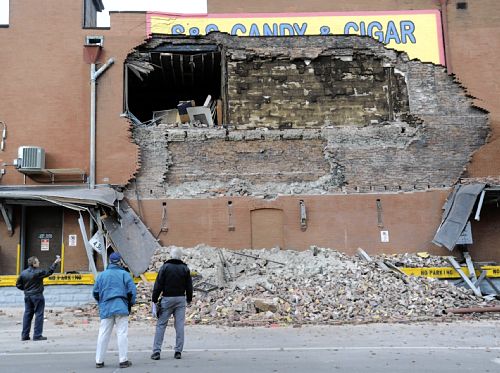
Pittsburgh building inspectors examine the partial collapse of a brick wall at S&S Candy and Cigar Co. at South 21st and East Carson streets on the South Side Monday morning. Bob Donaldson/Post-Gazette
Bricks and mortar rained onto 21st Street Monday morning, the likely result of water damage to the side of the S&S Candy and Cigar Co. at 2025 E. Carson St. on the South Side.
No one was injured.
An almost identical incident occurred in the morning when bricks fell from the side of a dentist’s office in Washington, Pa., damaging four cars.
Bob Farrow, division chief of Pittsburgh’s EMS department, said the outer layer of bricks on the S&S building gave out, followed by a crashing down of older bricks and mortar behind it.
The owner was not available to discuss the damage, but acting Bureau of Building Inspection Chief John Jennings said he suspected that water got in behind the veneer of bricks and pushed them out.
“We have seen this before, where water seeps in behind the brick, freezes and pushes the bricks out,” he said.
A structural engineer will be called in, he said. “We need to shore up the floor joists because they are compromised, but the damage is just to this one side. This building can be saved.”
Police closed South 21st Street between East Carson and Sidney streets. The parking lane alongside the candy store was covered with rubble.
Dozens of bystanders stared as the outer layer that had not fallen hung peeled back like a rind.
The candy and tobacco store has been in business in Pittsburgh since 1965.
In Washington, the brick facade of the dentist’s office detached without warning onto a side street, crushing four cars in the building’s parking lot.
Strong winds are being blamed for the collapse, according to what building owner Thomas C. Drewitz heard from insurers.
Emergency workers cordoned off the two-story building in the 800 block of Jefferson Avenue after the 10:40 a.m. incident. The city issued an emergency demolition permit to remove any loose bricks that had not fallen.
“Everything started to rumble and shake,” Dr. Drewitz said. “It went down fast.”
Dr. Drewitz said the building was constructed around 1965.
Three cars were totaled and a fourth suffered heavy damage.
“They were flat,” fire Capt. Nick Blumer said of the vehicles.
Dr. Drewitz closed the office for the day but said he planned to reopen today.
-
Historic District Building’s Wall Collapses in South Side
By Margaret Harding
PITTSBURGH TRIBUNE-REVIEW
Tuesday, February 15, 2011Historic District Building’s Wall Collapses in South Side
Francine Mykich was preparing S&S Candy and Cigar Co. for its busiest day of the week when she thought she heard a truck hit the South Side store.
“We came in just like a normal Monday morning, and then all of a sudden ka-boom,” said Mykich, who has worked at the business on East Carson and South 21st streets for 26 years. “We came outside, and it’s been steadily crumbling.”
A wall of the building, which dates to 1892, collapsed onto 21st Street about 8:40 a.m. Rubble covered the sidewalk and part of the street. All the employees safely evacuated the building, and no one was injured.
“The time of day was very fortunate,” Mykich said. “We weren’t open yet, thank God.”
The collapse likely was caused by moisture freezing between layers of brick and breaking the bonds between them, said John Jennings, the city’s interim building inspection director. When the bricks thaw, there’s nothing left holding them together, he said.
The owner of the building, identified in property records as Richard Stephens, has to get an engineer to stabilize the building before clean-up begins, Jennings said. Bricks and pieces of the building continued to fall throughout the morning. Through employees, Stephens declined to comment.
It could take a day or more to stabilize the building, Jennings said.
The building is part of the East Carson Historic District. It first appeared as Armour & Company Wholesale Meats in 1892, said Frank Stroker, assistant archivist with Pittsburgh History & Landmarks Foundation.
“It was probably their main facility at that point,” Stroker said.
Armour held the location until 1952. The building then briefly became home of Freezer Foods Inc., Stroker said. By 1956, Brinn’s China and Glassware moved in, he said, and held the spot until S&S took over in 1965.
City officials would have to approve any demolition, alterations or repairs because of its location in the historic district, said John Martine, an architect and member of the local advisory committee to the city’s Historic Review Commission.
Martine said he’s always admired a canopy along the side of the building. The collapse destroyed the canopy.
“It was a very simple, but interesting canopy with wonderful wood brackets that went the length of the loading docks,” Martine said. “It’s a very working-type building. It’s not that fancy, but there’s enough detail there that it would be a loss to see the building go.”
-
Deal Reached to Save Historic Franklin County House
Tuesday, February 08, 2011By Len Barcousky, Pittsburgh Post-GazetteDeal Reached to Save Historic Franklin County House
A history-loving physician has worked out a deal to save an 18th century home in Mercersburg.
Dr. Paul Orange said today the William Smith House will be taken apart piece by piece over the next several weeks and reassembled on a new site elsewhere in the Franklin County community.
The future of the building has been in question since the structure and land on which it stands were acquired two years ago by a local volunteer fire company. The MMP&W Fire Co., which has its headquarters and garages next door to the house on Main Street, bought the property for expansion and had announced plans to demolish the building.
That news resulted in the creation of a citizens group, the Committee to Save the Justice William Smith House. Members say that events planned in the stone Ulster-style cottage in 1765 resulted in the earliest opposition to British rule in the American colonies and laid the groundwork for the Second Amendment to the U.S. Constitution. That amendment guarantees the right to bear arms.
Dr. Orange, who has a family medical practice outside Chambersburg, estimated that the relocation project will cost as much as $250,000. He has agreed to fund at least $50,000 of that amount.
The first steps involve removing 19th- and 20-century additions to the structure, carefully taking apart and numbering stones and timbers from the core of the building and arranging for storage nearby. That process is likely to take several weeks, he said.
No decision has been made on where the house will be rebuilt. Several suitable properties are vacant along and near the borough’s Main Street.
Mercersburg is about 150 miles southeast of Pittsburgh.
-
Civic Arena a ‘Symbol of Genocide’
By Bill Vidonic
PITTSBURGH TRIBUNE-REVIEW
Thursday, February 3, 2011Former City Councilman Sala Udin was among the 8,000 residents and businesses in the lower Hill District who were displaced in the 1950s for construction of the Civic Arena.
On Wednesday, he urged Pittsburgh’s Historic Review Commission to reject a push to grant the arena protection under the city’s historic structure preservation law.
“This is more a symbol of genocide than a historic icon,” Udin said. “Demolish the arena and let the promise begin.”
During more than four hours of testimony, preservationists said that the arena’s distinct domed shape, its engineering and its place in the fabric of Pittsburgh’s history should spare it from a wrecking ball.
The city-county Sports and Exhibition Authority, which owns the building, and city Planning Commission have voted to demolish the building. The SEA had hoped to start in April, but the nomination for historic status has delayed that.
“There’s nothing like it anywhere else,” said Eloise McDonald of the Hill District, one of the people who nominated the structure in November. “That’s what makes it historical.”
Franklin Toker, a University of Pittsburgh art and architecture professor, said development and construction of the arena in the 1950s and ’60s coincided with “the most exhilarating, most creative and most ambitious moment this city has ever known: the Pittsburgh Renaissance.”
“It is the branding image for Pittsburgh, right under our noses,” Toker said.
A 2007 agreement between the Sports and Exhibition Authority and the Pittsburgh Penguins gave the sports franchise development rights for the 28-acre site.
Various representatives outlined a long-term redevelopment plan — one in which the arena is leveled — to make way for residential, retail and commercial development, creating thousands of jobs and millions of dollars in tax revenue.
City Councilman R. Daniel Lavelle, who represents the Hill District, said there’s no redevelopment plan for the arena itself.
“The hard truth is that the Civic Arena remains a symbol of failed public policy and a continual deterrence to economic viablility for the Hill District community. Historic designation and preservation, for many reasons, is not the correct decision. On the contrary, what might be more appropriate at this time is an apology for the historic injustices that were heaped upon the Hill District when it was torn asunder nearly a half-century ago.”
The city rejected historic status for the structure in 2002. The Historic Review Commission could make a recommendation next month; the city’s Planning Commission and City Council still must consider the request, a process that likely will stretch into summer.
-
Fate of Civic Arena Debated
Panel considering historic designation for Hill landmarkThursday, February 03, 2011By Mark Belko, Pittsburgh Post-Gazette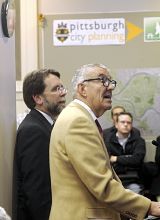
John Oyler, right, an engineer, talks Wednesday about how important the Civic Arena is as an example of structural engineering because it was done in the days before computer design. Speaking before the Historic Review Commission, he described how remarkable and unique the retractable dome is. Larry Roberts/Post-Gazette
To those who want to see it saved, the Civic Arena is an engineering marvel, an irreplaceable icon and a testament to Pittsburgh know-how.
But to those who want to see it go, the arena is “more a symbol of genocide” than a civic treasure, an aging relic with bad pipes, lousy acoustics and high maintenance costs.
So it went for more than four hours Wednesday during a public hearing before the Pittsburgh Historic Review Commission to determine whether the 49-year-old landmark should be designated as a city historic structure.
The commission, in a 5-1 vote last month, already gave preliminary approval to the designation, which would prevent the city-Allegheny Sports & Exhibition Authority from demolishing the building as part of a plan by the Pittsburgh Penguins to redevelop the site.
It is scheduled to take a final vote next month. Preliminary approval is no guarantee the arena will survive. In 2002, the panel gave similar approval to the designation only to reject it in a final vote.
Perhaps that’s the reason the nominator, Hill District resident Eloise McDonald, backed by Preservation Pittsburgh and Reuse the Igloo, and the SEA and the Penguins each spent more than an hour Wednesday advancing their arguments for or against designation.
Ms. McDonald and her allies believe the arena meets six of the 10 criteria that make a structure worthy of designation, including its location as a site for significant historic events, its exemplification of a rare, unique or innovative architectural style, and its unique location and distinctive physical appearance.
Only one of the 10 must be met to get a designation.
Franklin Toker, an architecture professor and the author of “Pittsburgh: A New Portrait,” argued that the arena “is, historically, the most representative building now standing in the city of Pittsburgh,” more so than the Cathedral of Learning, the county courthouse or the David L. Lawrence Convention Center.
He said the arena’s planning and construction “coincided exactly with the most exhilarating, most creative and most ambitious moment this city has ever known: the Pittsburgh renaissance.”
Others cited the arena’s retractable dome, one of the few in the world, or the engineering that made it work as reasons the old building should be saved.
Shawn Gallagher, the SEA’s attorney, said the agency doesn’t believe the arena meets even one of the 10 criteria for nomination.
He and others who support demolition said the arena requires millions of dollars in capital improvements, doesn’t meet accessibility standards and has no viable future as an entertainment venue.
“It clearly is not worthy of preservation,” Mr. Gallagher said.
City Councilman R. Daniel Lavelle said the arena, for many in the Hill, represents failed public policy, one that destroyed homes and businesses and displaced thousands of residents.
“This is not the sort of history we wish to preserve,” he said.
The hearing drew a number of other Hill residents who made similar comments, including former city Councilman Sala Udin, who said the arena is “more a symbol of genocide than a historic icon.”
And while some remember favorite concerts or exciting hockey games when they go into the arena, Hill resident Angela Howze recalls something else.
“Every time I go in there I remember it once was my grandmother’s house,” she said.
-
Iron City Allowed to Raze Building
By Bill Vidonic
PITTSBURGH TRIBUNE-REVIEW
Thursday, February 3, 2011The city’s Historic Review Commission will allow the president of Iron City Brewing Co. to tear down a dilapidated building at its former Lawrenceville production site.
The commission on Wednesday said Tim Hickman should provide it with photographs and other documentation of the 1,900-square-foot building for its records, but otherwise can proceed.
The city’s Bureau of Building Inspection cited the brewing company because of the distressed state of the building, but the site’s historic status — granted by the city last year — had complicated the issue of razing the building.
Commission acting chairman Ernie Hogan said state officials indicated that tearing down the former pipe shop shouldn’t interfere with the historic status or development tax credits. Hickman said the site could be developed for light industrial use and industrial warehousing.
Iron City moved production from Lawrenceville to Latrobe in 2009.
Hickman will have to talk to the commission next month about taking fermentation tanks out of another building. Hickman proposed removing two walls to do so; he said the building is useless with the tanks inside.
Also, Hickman has an agreement with the Pittsburgh Water and Sewer Authority to use the proceeds of the tanks’ sale to settle a billing dispute dating to 2007.
-
Historic Crafton Elementary School Threatened with Closure
PHLF News
January 28, 2011In 2010, the Carlynton School District conducted a district-wide facilities-use study on renovating or replacing its two elementary schools: the Carnegie Elementary School and the Crafton Elementary School.
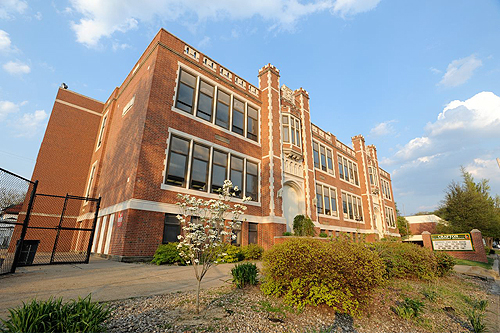
The Crafton Elementary School, built in 1913 and designed by architect Press C. Dowler, is a handsome Tudor-style building located at 1874 Crafton Blvd, a lovely residential neighborhood of Crafton Borough. The school is threatened with closure and ultimate abandonment in one of the options being considered.
Included in the Pennsylvania Historical and Museum Commission Architectural Survey of Historic Resources, the building has served as a community focal point for nearly a century and was one of the deciding criteria in selecting Crafton as the best place to raise children in Pennsylvania by Bloomberg BusinessWeek. The Crafton Elementary School is made of hand-burned brick laid in Flemish bond and has two projecting bays with crenelated tower projections, giving the building a stately appearance.
Crafton Councilwoman April Weitzel called the building a “gem of the community that has served and will continue to serve the citizens of Crafton and Carnegie.” Councilwoman Weitzel is convinced that renovating the school will be less expensive, resulting in no tax increases for the district. She further stated that “maintaining our neighborhood schools instead of abandoning them helps stabilize property values and encourages others to move into Carnegie and Crafton.”
Pittsburgh History & Landmarks Foundation would like to see this building continue being used as a school and has expressed its concern about possible closure of this important community asset. Renovation of historic schools is often less expensive than new construction. Restoration supports “green” policy and helps stabilize historic neighborhoods. This issue is scheduled to be discussed at the next School Board meeting. Comments can be sent to:
Carlynton School District
435 Kings Highway
Carnegie PA 15106
Click for MapBoard Meeting: Thursday, February 3, 2011 at 7:00 p.m. in the High School Cafeteria
and
Board Meeting: Thursday, February 17, 2011 at 7:30 p.m. in the High School Cafeteria -
Denis Theatre Foundation Names Executive Director
Thursday, January 13, 2011
Pittsburgh Post-GazetteThe Denis Theatre Foundation on Wednesday named Valerie Golik, the former executive director of The Pittsburgh Philharmonic, as its new executive director.
She replaces board member Jennifer Smokelin, who has served as interim director since the fall.
“We are delighted that Valerie is joining the Denis Theatre Foundation,” Ms. Smokelin said in a news release. “She brings with her an excellent background in arts management, programming, and a strong track record in fundraising and planning.”
When Ms. Golik, of Marshall, assumes the role Jan. 17, she will direct the foundation’s goal of restoring and re-opening the Denis Theatre on Washington Road in Mt. Lebanon. The theater, which opened in 1938, closed in 2004 in a state of disrepair. The nonprofit Denis Theatre Foundation formed in 2007 and began a fundraising campaign, with the goal of purchasing the building and restoring it as an independent film theater and community cultural center.
In September, the foundation announced it had raised enough money to purchase the building. Ms. Golik will assist with the capital campaign to raise $2.5 million to open the first of three planned screens. So far, the foundation has raised $900,000.
The foundation hopes to open the first screen in mid-2012.
“We are counting on broad support from individuals, businesses and charitable foundations from throughout the Pittsburgh area,” Ms. Golik said. “Once re-opened, the Denis will be a true regional asset.”