
Category Archive: Landscapes
-
County Urban Farm Effort Expands in Second Year
‘Allegheny Grows’ will donate produce to food pantries, families in needThursday, February 17, 2011By Len Barcousky, Pittsburgh Post-GazetteA new “urban farm” in Bellevue will help North Hills Community Outreach achieve one of its top goals for the more than 1,200 families it serves each year.
The fresh tomatoes, peppers and beans raised there this summer will aid the social service agency in assuring “adequate healthy nourishment for the people who use our food pantries,” executive director Fay Morgan said.
Bellevue’s new garden will be part of the second year “Allegheny Grows” urban-agriculture effort. Bellevue, Wilkinsburg and Penn Hills were selected last week to participate in the expansion of the program.
Their projects were selected from among proposals submitted by a dozen municipalities and their local partners.
The community gardens and urban farms that Allegheny Grows sponsors offer environmental, economic, social and educational benefits, project manager Iris Whitworth said. She works for the county’s economic development office.
Communities and projects were picked based on strong municipal leadership, enthusiasm of local volunteers, suitability of their garden site and community need, Ms. Whitworth said.
The effort has the support of County Executive Dan Onorato. “Allegheny Grows builds on the county’s ongoing initiatives to revitalize older communities and distressed municipalities through sustainable development and strategic investment,” he said in a statement.
This year’s budget for Allegheny Grows is about $75,000. In addition to setting up new projects in the three communities, the funds will be used to cover second-year costs for garden projects begun last year in Millvale and McKees Rocks.
Gardeners in both communities will get seedlings and technical advice. Millvale’s project also will receive rain-collecting barrels, and McKees Rocks will get help in edging its garden beds and making them accessible to people with disabilities.
The money for Allegheny Grows comes from federal community development block grants.
Local partners in each community will work with “Grow Pittsburgh,” which was formed in 2005 to encourage city gardening, and with the Western Pennsylvania Conservancy. The Western Pennsylvania Conservancy is well known for its summer flower gardens. Working with various partners, it plants 140 of those in 20 counties.
The organization also has been long involved in support for vegetable gardening, Judy Wagner said. She is the director of the conservancy’s community gardens and greenspace programs. Its community garden projects were common in the 1980s as the region’s steel industry collapsed, she said. Many families turned to growing food for themselves and their neighbors.
More than a year ago, the conservancy and Grow Pittsburgh teamed up to teach people how to grow food in urban setting.
Conservancy staff will work on design and construction at all three sites while Grow Pittsburgh will take lead in training volunteers.
BellevueBellevue’s project will be on Davis Avenue on a 13,500-square-foot tract owned by North Hills Community Outreach. The land had been donated in 2008 by Terrie Amelio, of McCandless, to the social-service agency. The site will be named the Rosalinda Sirianni Memorial Garden in honor of Mrs. Amelio’s mother, Ms. Morgan said.
Most of the labor for the organic farming effort will be provided by volunteers, who will be supervised by a part-time community outreach employee, Ms. Morgan said. Produce grown there will be donated to food pantries.
Bellevue will supply water for the garden, and two foundations are among those aiding the effort. The Comcast Foundation will provide funds to hire the part-time coordinator, and the Grable Foundation has given money to pay local youth helpers to work with the volunteers.
WilkinsburgWilkinsburg’s urban farm will be part of a 2-acre site on Jeanette Street in the city’s Hamnett Place neighborhood. The land is owned by Pittsburgh History and Landmarks Foundation, which already is involved with several housing renewal projects in the community. Allegheny Grows will be working with a citizens organization called Hamnett Place Community Garden Association to plant and care for the site.
The site will have 16 individual plots and can be expanded to more than 20, garden association president Rachel Courtney said. Another portion of the vacant lot will be converted into a play-and-learning area for neighborhood children.
Local residents are already planning their own plots. “A woman from Jamaica has told us she hopes to grow things that she can’t find in the grocery stores here,” Ms. Courtney said.
“Buildings are not what make communities,” Karamagi Rujumba said. “People make communities.”
That is why his employer, the Pittsburgh History and Landmarks Foundation, is assisting in the Allegheny Grows effort, he said. Mr. Rujumba is coordinator of landmarks foundation programs in Wilkinsburg.
The garden and adjoining children’s “learning space” should teach people practical gardening skills and give them a sense of ownership in their community, he said.
The Hamnett Place project also has received funding from the Heinz Endowment, the Richard Mellon Scaife Foundation, Allegheny County and the state.
Penn HillsPenn Hills will provide water and leaf-mulch compost for an expanded community garden that occupies the site of a former municipal ballfield in the 1100 block of Jefferson Road.
Local Boy Scouts last year helped to clear and prepare the site for gardening as an Eagle Scout project, Ed Zullo, president of Penn Hills Community Development Corp., said.
The site had been divided into a dozen raised garden beds, and plans for this spring call for almost doubling that number to 22 plots.
Gardeners last year raised vegetables both for their families and donated baskets of tomatoes and peppers to two local food pantries, Mr. Zullo said. That effort likely will expand to benefit a third pantry this year.
His agency’s partnership with Allegheny Grows could mark the start of efforts to create additional agricultural sites across Penn Hills, he said.
Community gardens offer multiple benefits, supporters say. They provide fresh, healthy food and they can improve the appearance of blighted land. Their vegetation helps to reduce storm-water run-off, and the flowering plants growing there help support bee colonies and other pollinators.
They also have less obvious advantages. “Neighbors in Millvale really enjoy working together,” the conservancy’s Ms. Wagner said. “You are growing your community as you are growing vegetables.”
Mr. Zullo agreed that gardens can serve as a development tool. “We get neighbors of different generations and different races interacting,” he said. “Old people teach young people, and neighbors compete over who has grown better tomatoes.”
-
Public Gets Hands-On With Ideas for South Park Fairgrounds
Thursday, December 09, 2010By Margaret SmyklaThe public put its money where its mouth was during a public meeting last week about the future of the South Park Fairgrounds.
Everyone in the audience was given $500 in fake money to play a kind of board game, placing the “money” on an element that the player thought was a priority.
Elements receiving heavy play included removing Schoonmaker Hall, improving the oval fields/track surfaces and enhancing the park gateways.
A popular write-in item was “improving bathrooms.”
The input from this meeting, as well as another public meeting in September and focus groups and an online survey will be incorporated into a report from GAI Consultants, of Homestead, that is planned for completion at month’s end.
The study is supported by the Richard King Mellon Foundation, the Heinz Endowments and the county.
While there is no money in hand for improvements, the county is more likely to receive funding from foundations, and the state and federal governments, if a plan is in place, said county parks director Andy Baechle. There is no timetable.
The process was set in motion through a master plan created several years ago for all nine county parks. One of its recommendations was the formation of a nonprofit parks foundation to which tax-deductible donations could be made.
That done, the master plan was again addressed, such as its call for a detailed vision of the 76 county-owned acres from Corrigan Drive to McCorkle Road encompassing the Fairgrounds, exhibit hall buildings, amphitheater, police barracks, Nature Center, tennis/basketball courts, and more.
“This area has a tons of potential, but it has lagged,” said Jeaneen Zappa, the Allegheny County’s sustainability manager.
At the meeting, three options — titled “Modified,” “Campus” and “Picturesque” — were presented to solicit comments from the audience.
The “Modified” option is based on what can be done fairly easily and economically, such as removing/repairing bleachers, improving oval fields/track surfaces and enhancing park gateways.
With “Campus,” which emphasizes pedestrians, the recommendations include removing Agricultural Hall for additional parking, adding a “green” parking lot at McCorkle and Brownsville roads and reclaiming the southern end of Catfish Run.
“Picturesque” focuses on the naturalistic quality of the park’s original planning, such as reconfiguring the oval track to curvilinear shape, relocating the tennis/basketball courts and relocating the nature center adjacent to Catfish Run.
Ms. Zappa said the final report will likely include elements of all three,
Christine Fuller, executive director of the Allegheny County Parks Foundation, said the organization will review the final report and work with the county on the next steps.
After the meeting, Jeff Danchik, director of the Mon Valley Express, a drum and bugle corps which leases space from the county at Brownsville Road and Corrigan Drive, said the area needs more attractions, such as a craft shows or flea markets.
“A lot of people don’t know we’re here,” Mr. Danchik said.
Walt Sackinsky of South Park said he would like to see the infrastructure addressed, such as aging water, gas, and sewer lines, and fire hydrants.
For Terry Tressler of South Park, priorities include improvements to Corrigan Drive such as adding a middle turning lane with room on each side of the road for walkers and bikers.
His wife, Donna Tressler, would like to see Schoonmaker Hall, which is used for storage, razed. “It is falling down and dangerous, with kids going in and out,” she said.
A big priority for both is improving the bathrooms.
The couple, lifetime park users, are hopeful for change after attending both public meetings.
“I’m impressed with the caliber of people who seem to want to improve the park,” he said.
-
3 Options Offered to Revitalize South Park
By Matthew Santoni
PITTSBURGH TRIBUNE-REVIEW
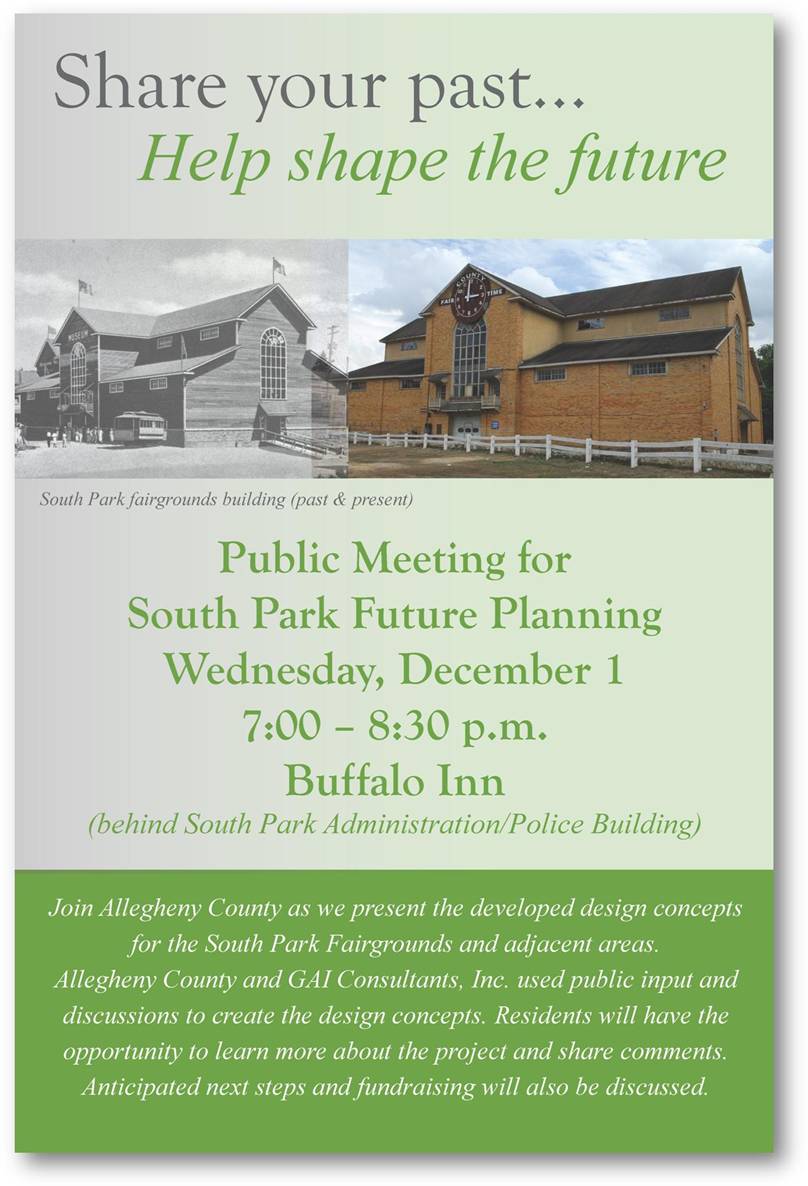
Thursday, December 2, 2010A cluster of former fairground buildings along Brownsville Road in South Park could get a green makeover, under three plans officials presented Wednesday night as part of Allegheny County’s effort to revitalize the park.
Titled the “modified,” “campus” and “picturesque” concept plans, each offers an increasing degree of replacing parking lots, roads and rundown halls with green space and walking paths, said Todd Brant, project manager for Homestead-based GAI Consultants.
The modified plan would demolish Schoonmaker Hall, replace some parking lots with grassy areas that can still support overflow parking and add more pedestrian pathways to the site, which Brant said is “a sea of asphalt.”
“The fairground is unique in this large concentration of buildings, but it’s not as park-like as the rest of the park,” he said.
The campus plan would go slightly greener by moving more parking near McCorkle Road, cutting out sections of access roads and demolishing a few more of the old fair buildings.
The picturesque concept would go furthest by removing the oval track and replacing it with a more meandering walking trail. The bleachers, tennis and basketball courts would be removed and replaced with trees, and the concrete channel for Catfish Run would be removed for a more natural-looking stream.
County Parks Director Andy Baechle emphasized that the plans, which won’t be finalized until the end of the year, will only be a guide until funding to make the changes is found.
“We don’t have funding in hand to do things right away,” he said. “But with this plan and good public participation, we’re more likely to get money from foundations, from the state and federal governments.”
The plans will be posted online today and public surveys can be taken until Sunday at alleghenycounty.us/parks/SPFairgrounds.
-
Plans for South Park Fairgrounds to be Aired Wednesday
By Matthew Santoni
PITTSBURGH TRIBUNE-REVIEW
Tuesday, November 30, 2010Allegheny County officials will show off plans for upgrading the South Park Fairgrounds and surrounding areas Wednesday, after months of meetings and public input on what to do with the aging site of the defunct county fair.
Three plans center around improving pedestrian connections to the 80-acre site; aggressive maintenance of buildings; “greening” the grounds with vegetation and less pavement; returning nearby Catfish Run to a more natural state; and remaking the field and track next to the fairground buildings, said Jeaneen Zappa, county sustainability manager.
Each plan will tackle those goals with differing degrees of intensity, but none of the changes is intended to be drastic.
“There are things we can do more readily than others without making enormous changes,” Zappa said. “It’s not as though somebody took a drawing of the site on a chalkboard and erased it completely.”
Catfish Run, which flows through a pipe beneath the fairgrounds and a culvert between the track and an access road, could be restored to natural banks with vegetation. The Nature Center, located in the middle of “an island of asphalt,” could be moved to a fairground building closer to the stream and the head of several park trails, Zappa said.
Vehicular traffic through and around the site could be rearranged so that it is less redundant and confusing, she said.
Though county officials don’t have specific plans for the fairground buildings, many people who spoke during a public hearing in September want the county to rent more buildings to community groups.
“The best thing would be to remodel the buildings on top of the hill,” said Joseph Hedderman, chief instructor at Allegheny County Budo-Kai, a martial arts school that has occupied one of the buildings since the 1980s. “All of these little buildings could be signed over to groups and remodeled like ours.”
During the past two months, teams from Homestead-based GAI Consultants gathered ideas from people about what they’d like the county to do with the fairgrounds and parts of the surrounding park. Online surveys are available at alleghenycounty.us/parks/SPFairgrounds.
The meeting will be held from 7 to 8:30 p.m. in the Buffalo Inn, off Buffalo Drive near the intersection of Brownsville Road and Corrigan Drive.
-
Welcoming Vandergrift has Plenty of Special Features
By Bob Karlovits, PITTSBURGH TRIBUNE-REVIEW
Monday, November 22, 2010Many small towns have rich stories, but few tell them as well as Vandergrift.
Part of that tale is in the layout of the historic area of the 115-year-old town. Designed by the firm of Frederick Law Olmsted, the creator of New York City’s Central Park and many academic campuses, the streets arch over and around the hillside on which the town is built.
A grand theater, the Casino, sits facing a mall leading down to a train station. It was given that spot intentionally to offer a welcome to anyone arriving in the Westmoreland County town.
The town was built to provide a home for workers at the steel mill of George McMurtry. The mill has had six owners since its first, but still is working, despite the decline of the steel industry.
All of those features make Vandergrift a place where the past is a major part of the present. It makes it worth a visit to see that story.
1:30 p.m.
The Victorian Vandergrift Museum is in a school built in 1911 and, like many features of the town, is a work in progress.
With displays on three floors, it tells the story of the town in a number of ways. On the bottom floor is a room decorated with many pictures of initial work on the town along with map of the plans originated by the Olmsted firm.
If you’re lucky, you might run into Bill Hesketh, treasurer of the museum and historical society. He could tell you about McMurtry, owner of Apollo Iron & Steel, wanting to build a town that would attract workers and entice them to stay.
He would do that by having the famed designers draw up a plan for the ultimate company town. McMurtry thought a cultured worker was a good worker, so included plans for the Casino. He also saw the benefit of religious life, so provided $7,500 to any congregation planning to build a church costing $15,000 or more. He wanted sober workers, so the town was dry until 1936.
If you are lucky, Hesketh will be there to offer you some thoughts. But it will take some luck. He does not schedule tours or times he is there for visits. There are no other guides at the museum either. But simply wandering around the museum will provide a look at what Vandergrift is all about.
Victorian Vandergrift Museum, 184 Sherman Ave. Hours: 10 a.m. to 3 p.m. Mondays to Saturdays. Details: 724-568-1990.
3 p.m.
Now, it’s time to take to the streets. In some ways, the rows of houses are the story of Vandergrift.
The look of the town is somewhat defined by the rows of company homes on streets that are devoid of 90-degree angles.
When the Olmsted designers laid out the plan, Hesketh says, they decided on 50-feet-wide lots, but McMurtry thought that was way too wide. He was selling the lots, and wanted to profit from them.
They became 25-feet-wide, leading to streets of homes generally built tightly together.
Hesketh points out some people eventually bought two homes and built them together to make one bigger residence. Or they bought one and tore it down to create a bigger yard. There are some properties that were sold as 50-feet-wide and are the sites of some nicer homes, for the non-laborer class.
Take a walk around and look at the history of a town as seen in its homes. The look of the town is created by the past and the gentle curves of the Olmsted design, which even creates a non-straight business district.
5:30 p.m.
After touring Vandergrift and getting ready for the finale of this day, it is time for dinner.
There are some likely stops for a meal in town, and these three win local praise. You probably saw them as you wandered around.
The G&G Restaurant (724-567-6139) on Columbia Avenue is largely a breakfast and lunch place, but is open till 9 p.m. for dinner.
A.J.’s Restaurant (724-568-2464) is open Tuesdays, Wednesdays, Thursdays and Saturdays until 10 p.m. and 11 p.m. Fridays.
Offering a more specific dinner outlook is the Steeltown Smokehouse (724-568-4087) on Washington Avenue. The burgers-and-wings emporium is open till 8 p.m. Mondays to Thursday, 9 p.m. Fridays and Saturdays and 6 p.m. Sundays.
7 p.m.
The best way to do this trip is to pay attention to the shows at the Casino, which can be checked out at www.casinotheater.org, then plan a visit on a day ending with some entertainment.
Make sure to arrive at the Casino with enough time to look around.
The oldest, active theater in Western Pennsylvania had become a unused shell when a group that became Casino Theatre & Restoration Management took it over in 1991, Hesketh says. They brought the site back to life.
Trumpet star Maynard Ferguson (1928-2006) performed there along with the Vogues and the Clarks. The renovated theater has been the home of stage presentations. Some of the restoration meant changes from the original, Hesketh says, but some of that provided aspects that seemed to be needed.
“This place just called for boxes,” he says, pointing to box seats on each side of the stage.
Roam around the Casino. The balcony casts a good and attractive view of the stage. The lobby, slightly smaller than what it once was, offers an attractive entrance.
McMurtry thought the Casino would be a significant part of the town when it was built in 1900.
It still is.
-
Old Pittsburgh Churches are a Sight to See
By Deborah Deasy, PITTSBURGH TRIBUNE-REVIEW
Monday, November 29, 2010t’s easy to overlook the oldest churches in Pittsburgh.
“Then, you come inside and see how beautiful it is,” says Sean O’Donnell, secretary at Smithfield United Church of Christ, one the city’s four oldest houses or worship.
The others — all soaring stone structures within blocks of each other — are the First Presbyterian Church and Trinity Cathedral, both on Sixth Avenue, and the First English Evangelical Lutheran Church on Grant Street.
One claims the grave of a Shawnee Indian chief. One has 13 Tiffany stained glass windows insured for $2 million. One boasts the world’s first architectural use of aluminum. One has a marble, wood and brass altar once exhibited at the Carnegie Museum of Art.
Each offers an oasis of quiet — at no charge — and sights to please even the most agnostic art lover. All offer free, informational brochures and tours upon request.
“These are real treasures for people to look at,” says the Rev. Catherine Brall, canon provost at Trinity Episcopal.
Visiting the churches helps one appreciate the city’s architectural history, along with “the depth of faith and piety that created these beautiful buildings,” says the Rev. David Gleason, senior pastor at First English Evangelical Lutheran Church.
On a recent Friday, the First Presbyterian Church wowed curious passers-by from Wyoming, Arizona, Ohio and Virginia.
“I think going to a church is a beautiful thing, regardless of your religion or politics. There are so many aspects that can be shared and appreciated,” says Morrison Simms of Jackson Hole, Wyo.
Simms’ companion — Stuart Herman of Scottsdale, Ariz. — believes a visit to such places helps couples discover and appreciate each other’s interests. “It opens dialogue,” he says.
Two of the churches — Trinity Cathedral and First Presbyterian — also offer sit-down eateries for weekday visitors. The Franktuary at 325 Oliver Ave. — under Trinity Cathedral — offers vegetarian, organic beef and gourmet hot dogs from 10 a.m. to 3 p.m. Mondays to Fridays. Our Daily Bread at 320 Sixth Ave. — under the First Presbyterian Church — serves hot lunches, soups, sandwiches and salads from 10:30 a.m. to 2 p.m. Mondays to Fridays.
Trinity Cathedral (1872), Architect: Gordon W. Lloyd.
A plaque on the cathedral’s black iron fence describes the site as Pittsburgh’s “oldest unreconstructed landmark.”
Trinity Cathedral and the First Presbyterian Church share a former American Indian burial ground deeded by William Penn’s heirs to the congregations’ forefathers. French soldiers at Fort Duquesne (1754) and British soldiers at Fort Pitt (1758) also used the ground for burials.
Today, Trinity Cathedral maintains the last 128 marked graves of an estimated 4,000 people once buried on the site. The identified remains of many have been moved to other cemeteries. The unmarked bones of many others remain interred within a crypt in the sub-basement of First Presbyterian.
Prominent folks recorded on the present tombstones include Red Pole, principal chief of the Shawnee Indian nation, and Dr. Nathaniel Bedford, Pittsburgh’s first physician and a founder of the University of Pittsburgh.
Inside the cathedral, visitors will find hand-carved pews of white mahogany, a stone pulpit covered with intricate carvings of prophets, saints and bishops, plus, stained glass windows dating back to 1872.
Trinity Cathedral, 328 Sixth Ave., Downtown. Hours: 7 a.m. to 1 p.m. Sundays, 7 a.m. to 5 p.m. Mondays to Fridays, 9 a.m. to 1 p.m. Saturdays. Services available at 12:05 p.m. Mondays to Saturdays and 8:45 a.m. and 4:45 p.m. Mondays to Fridays, and 8 and 10:30 a.m. Sundays. Details: 412-232-6404 or here.
First English Evangelical Lutheran Church (1888), Architect: Andrew Peebles.
A 170-foot-spire distinguishes the First English Evangelical Lutheran Church, second oldest structure on Grant Street. Only nearby Allegheny County Courthouse & Jail is older.
Interior decorations include a contemporary cross by Virgil Cantini; the 500-square-foot “Good Shepherd” window of Tiffany Favrile glass, and a free-standing marble, brass and wood altar once displayed at the Carnegie Museum of Art.
Also notable is the “The Presentation of Our Lord in Temple” lunette, a shimmery glass mosaic and cloisonne work made in the late 1800s. It hangs high above the church’s permanent marble altar.
Newest additions to the landmark include a 100-drawer columbarium for the cremated remains of church members and friends of parish. “There’s enough room for 200 bodies,” says senior pastor Gleason. “It’s designed as a special reliquary. … These are the bones of our saints.”
First English Evangelical Lutheran Church, 615 Grant St., Uptown. Hours: 8 a.m. to 4 p.m. Mondays to Fridays; 8:30 to 12:30 p.m. Sundays. Services available 12:10 p.m. Mondays to Fridays, 8:30, 9:45 and 11 a.m. Sundays. Details: 412-471-8125 or here.
First Presbyterian Church (1903), Architect: Theophilus Parsons Chandler
Tiffany Studios designed 13 of the church’s 26-foot-by-7-foot stained glass windows, now insured for $2 million. All were hand-painted, making them unique among Tiffany windows.
“Each of the windows cost $3,000 when the building opened in 1905,” says Bob Loos, a deacon who gives tours. “As soon as you get a little sunlight coming in, they take off in brilliance.”
The Tiffany windows, however, are just a few of the 253 stained and leaded glass windows throughout the sandstone church.
Also notable are two 80-foot ceiling beams — each cut from 150-foot Oregonian oak trees — plus, a pair of rolling, two-ton, 30-foot oak doors in the sanctuary. “They operate on a track in the floor. … and are so perfectly balanced that one person can open or close each one,” reports the church’s free guide for visitors.
Visitors also will notice untold carved birds, animals and insects on the church’s interior stonework, including an eagle, butterfly and dove on the pulpit — representing the Father, Son and Holy Spirit.
First Presbyterian Church, 320 Sixth Ave., Downtown. Hours: 10 a.m. to 3 p.m. Mondays to Fridays, 9 a.m. to noon Sundays. Services available at 12:25 p.m. Tuesdays and 10:45 a.m. Sundays. Guided tours offered after the 10:45 a.m. Sunday service. Details: 412-471-3436 or here.
Smithfield United Church of Christ (1926), Architect: Henry Hornbostel
An airy, 80-foot aluminum steeple — supported by interior steel beams — marks the multilevel Smithfield United Church of Christ. It’s the sixth house of worship for the city’s first organized Christian congregation. The spire “has the distinction of being the first architectural use of aluminum in the world,” according the church’s Spire bulletin.
“The sanctuary reminds me of some of the big cathedrals in New York City,” says O’Donnell, the church secretary. “I was most taken by the plaster work.”
Interior features include a 19-foot rose window made in 1860, and 12 towering, stained-glass windows that illustrate Biblical scenes and Pittsburgh history, including an 1861 visit by President-elect Abraham Lincoln.
Smithfield United Church of Christ, 620 Smithfield St., Downtown. Hours: 9 a.m. to 3 p.m. Mondays to Fridays; 9:45 a.m. to noon Sundays. Services available at 12:10 p.m. Wednesdays and 11 a.m. Sundays. Details: 412-281-1811 or here.
-
Public Meeting for South Park Future Planning

-
Unusual Touches Mark Phipps’ Winter Show
Saturday, November 20, 2010The Winter Flower Show opens Friday at Phipps Conservatory and Botanical Gardens in Oakland. Nine of the indoor gardens will be bedecked with topiary snowmen, decorated trees, hanging baskets, thousands of lights and more than 2,000 poinsettias. Newer varieties of poinsettias will be on display, including ‘Polar Bear,’ ‘Winter Blush,’ ‘Ice Punch,’ ‘Visions of Grandeur’ and ‘Tapestry.’
Also on display is the garden railroad with operating trains and miniature living scenery that includes dwarf conifers. The show, which runs through Jan. 9, was designed by the conservatory staff with help from Michele McCann.
“The show is a wonderful combination of horticulture and whimsy, with beautiful new poinsettias and common annuals used in unusual ways,” says Margie Radebaugh, Phipps’ director of horticulture and education.
Special seasonal events include:
• Visits by Santa Claus on Saturdays and Sundays through Dec. 19.
• A “Garlands & Gifts” sale on Dec. 2-3 from 10 a.m. until 7 p.m.
• Phipps stays open until 10 p.m. daily, beginning Dec. 6, with candlelit walkways and live entertainment.
Admission is $12 for adults; $11 for seniors 62 and older and students with valid ID; $9 for children ages 2 to 18; free for children under 2. Information: www.phippsconservatory.org or 412-622-6914.