Category Archive: Main & Elm Street Programs
-
Main Street Work in Dormont and Carnegie
After three productive meetings with community stakeholders in Dormont and Carnegie this spring, the Pittsburgh History & Landmarks Foundation is compiling planning documents for the two boroughs, which are the latest entrants into Allegheny County’s downtown revitalization program.
Allegheny Together, a comprehensive downtown revitalization program aimed at improving the physical attributes and businesses of its participating communities started in 2007. Since then, PHLF has served as a co-administrator of the initiative.
The program is funded by Allegheny County and its participating communities include Bellevue, Bridgeville, Coraopolis, Elizabeth, Stowe, Swissvale, Tarentum, Verona, and the two newest participants Dormont and Carnegie.
First, PHLF is putting together a strategic plan to evaluate how the commercial district currently functions, make recommendations for improvements, identify opportunities for new types of businesses based on market research, and overall trends in a variety of census data categories.
We have also been reviewing the current zoning and building codes for Dormont and Carnegie, and making specific recommendations for ways to encourage historic preservation, guide new construction, and allow for good signage. These recommendations are designed to aid the local planning commissions and councils in updating the current signage and zoning ordinances.
We examined the parking and traffic issues in Dormont and Carnegie, and have compiled a report detailing parking availability in and around the commercial district, traffic flow at key intersections, and made recommendations to alleviate any issues.
Finally, design guidelines are being finalized that will aid business and property owners in the commercial district in making appropriate physical improvements to the facades of their properties. The design guidelines are meant to be a guide, to inspire individuals to make improvements, and to be a resource for anyone that wants to understand how to make good improvements to commercial properties.
We look forward to sharing our work with the communities in the near future.
-
Grant to Help Return Saxonburg Main Street to 1850s
Thursday, February 10, 2011By Karen Kane, Pittsburgh Post-GazetteSaxonburg’s Main Street program manager says he’s feeling “pretty blessed” by the news last month that the Pennsylvania Department of Transportation had come through with a $1.4 million grant.
The money was both needed and expected. But, Raymond Rush said he was happy it was all official.
“We’ve been blessed by PennDOT and beyond,” he said.
Design and engineering work is under way for reconstruction of both sides of Main Street — a four-block section of the street that spans about 2,200 feet from Butler Street to Rebecca Street. Those costs are being covered by a $373,027 grant awarded in May by the Department of Community and Economic Development.
Now, PennDOT has come through with a $1.4 million grant for construction of half of the project: from Pittsburgh Street west to Rebecca Street.
The work will involve reconstructing sidewalks and curbs, and installing landscaping. Street lights that replicate old-style German lights will be installed.
The first half of the project is to be under way in the second half of the year with finishing work in the first quarter of 2012, Mr. Rush said. Sometime early in 2012, he’s expecting to hear that PennDOT is coming through with the rest of the funding. The total project cost is estimated at $2.4 million. The second half of the project would start during the 2012 construction season. Mr. Rush predicted the job would be completed within a year’s time.
He credits receipt of the grants to a partnership between the borough and the John Roebling’s Historic Saxonburg Society Inc., a nonprofit group that sponsors the Main Street program. The society is named for the town’s founder who invented wire cable and is famous for bridge design. One of his most notable projects was the Brooklyn Bridge in New York.
Saxonburg’s Main Street is an official historic district on both state and national levels. There are 52 historic buildings in the four-block project area, including Mr. Roebling’s home. A native of Germany, he designed the borough.
Mr. Rush said the reconstruction project will maintain the borough’s historic look while modernizing the infrastructure.
“It will bring the 1850s look into modern society,” he said.
-
Row-House Museum Harrison Group’s Top Goal for 2011
By George Guido,
FOR THE VALLEY NEWS DISPATCH
Wednesday, January 26, 2011Bill Godfrey of Natrona Comes Together, the grassroots neighborhood improvement group, says the group has a list of goals for this year for this aging, riverside neighborhood that’s nestled between two steel mills.
One is establishing a row-house museum on Federal Street.
The project would restore a row house to its original state and be operated by the Pittsburgh History & Landmarks Foundation.
Residents have been donating artifacts to the proposed museum, but the discovery of a $6,000 tax lien on the property possibly could complicate the project.
A steel heritage sculpture is proposed for the corner of Federal and Blue Ridge Avenue.
Natrona Comes Together needs $1,300 to buy the vacant property.
The sculpture will resemble the coal miners’ memorial sculpture in the Harwick section of Springdale Township and will be sculpted by New Kensington native Steven Paulovich. The parklet will be managed by the Rivers of Steel Group, based in the Mon Valley.
Another project involves ongoing additions to the Natrona playground.
A concession stand, bike racks, landscaping and a horseshoe-pitching court are among the planned items for the $142,000 federal grant.
Godfrey’s group hopes to have the former bank building renovated to the point where it could be sold, rented or leased to a private business.
The Natrona group also hopes to get AmeriCorps members to help manage the park and mow grass on vacant properties in the community.
-
Saxonburg Gets $1.4 Million for Main Street
By Tom Fontaine
PITTSBURGH TRIBUNE-REVIEW
Friday, January 7, 2011Saxonburg has received a $1.4 million state grant to make long-awaited improvements along historic Main Street without robbing any of its 19th century charm.
“We’re going to take new materials and create an atmosphere like it was in the 1850s and ’60s,” said Ray Rush, who will oversee the project for the tiny Butler County borough.
Saxonburg’s grant was the largest of six totaling more than $4.4 million announced Thursday by PennDOT. The agency awarded almost $25 million statewide through its Pennsylvania Community Transportation Initiative. The program provided $59.2 million for transportation projects in 2009.
Saxonburg will use its money to install new curbs, brick sidewalks, planter strips with trees, and period lighting along 1,100 feet of Main Street. That will cover roughly half of the area that is recognized as a historic district both nationally and by the state.
The borough can trace its roots to engineer John Roebling, famed for his designs of wire cable and suspension bridges. He designed and developed Saxonburg almost four decades before he began designing the Brooklyn Bridge in the late 1860s.
“It’s important to celebrate the old. It’s something all communities should be concerned about,” Rush said. The work will begin next fall and should be completed in 2012.
The city of Pittsburgh will receive $280,000 for a traffic study in the Strip District and Lawrenceville related to its Allegheny Riverfront Green Boulevard development project. The city wants to help make its largely industrial Allegheny riverfront home to lush green spaces, trails, housing, commercial development and commuter rail.
“This most recent grant will allow us to continue the positive momentum that is happening in these vibrant neighborhoods,” said Mayor Luke Ravenstahl.
Other grant recipients include:
• Richland, $1.3 million, to improve pedestrian access and traffic flow near the intersection of Route 8 and Ewalt Road.
• Airport Corridor Transportation Association, $700,000, to reduce congestion and provide better transit, pedestrian and bicycle access in the Robinson and North Fayette commercial area.
• Washington County, $443,500, to develop 9 miles of recreational trail to complete the Panhandle Trail between Carnegie and Weirton, W.Va.
• Armstrong County, $300,000, to perform a traffic study in Kittanning.
-
T & T Hardware Closing After 74 Years
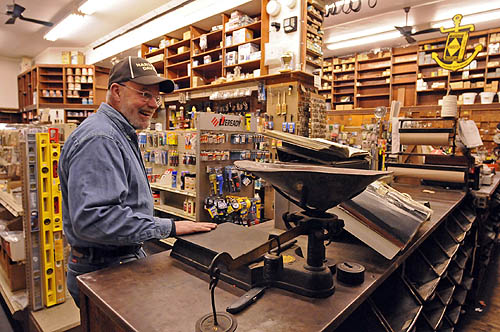
Friday, November 19, 2010By Emily Gibb, Pittsburgh Post-GazettePull open the solid wood door with its weathered red paint, walk into T & T Hardware Co. Inc. on the South Side and it’s a bit like stepping back in time.
Wooden shelves line the walls, some all the way to the ceiling, along with rows and rows of little wooden drawers full of screws, nuts and bolts behind a wooden counter along the back. Power tools almost seem out of place in their wood and glass displays.
But next week, after fighting off hard times the last few years, the hardware store fixture on Carson Street begins the process to shut its doors for good.
The “mom and pop” store has too much remaining inventory to liquidate or auction off yet, so beginning Monday, everything is 50 percent off the original price, said manager Mark McNally, 55, of Mount Washington.
They are waiting to see how long it takes to sell most of their inventory to set an exact closing date. This week, they’re just trying to get everything out on the shelves.
Stanley Tumas opened T & T Hardware in 1936. After he retired in the late 1980s, his son, Michael Tumas, took over ownership of the store.
It has stayed in the same spot for the last 74 years, expanding to the side and to the back as the years went on. It was a work in progress until the ’80s, Mr. McNally said.
He says they’ve always had a reputation as the place to go for “odd stuff that no one else has,” like specific plumbing parts, nuts, bolts or screws.
Since he began working at a hardware store in Mount Washington as a teenager and then managing T & T Hardware for the last 15 years, Mr. McNally has seen many changes in the business.
Part of the challenge comes from “big box” stores, like Home Depot. “They’re key why these stores are going,” he said.
Competing with a Lowe’s only five miles away has been difficult.
“It’s just too close. I can show you on my books when they opened,” he said.
Besides competing with large chains, they are competing with the economy as well.
A lot of their business used to come from commercial contractors, but if the contractors don’t have jobs to do, they won’t be coming the hardware store for supplies.
On top of the struggling economy, the South Side is a changing neighborhood.
“For a store like this, the neighborhood has to support it,” he said.
But most people in the neighborhood now rent their houses. Generally, renters aren’t in need of hardware supplies when they can just call their landlord to take care of things.
Saturday used to be the busiest day of the week for a hardware store, Mr. McNally said. Customers who had the day off work would buy their home improvement supplies in the morning. If they were having problems, they would return around noon. If they were really having problems, they would be back again around 3 p.m., Mr. McNally said.
But last year, he started closing on Saturdays — they didn’t have enough weekend business to make it worthwhile anymore.
At one time there were four or five hardware stores just on the South Side, but, he says, “times change. I understand that.”
As Mr. McNally starts a new phase, he has to say goodbye to more than a store and a building.
“The people, without a doubt — that’s what I’m going to miss the most. After 15 years you make good, good friends,” he said.
-
$25,000 Grant a Major Boost in Restoring Wilkinsburg’s Business District
Wednesday, November 10, 2010
Pop City Media
Wilkinsburg’s main commercial district on Penn Avenue suffers from a 38% vacancy rate, but a $25,000 grant from State Representative Joseph Preston Jr. to the Wilkinsburg Community Development Corporation is the most recent achievement for the growing two year old organization hard at work to revitalize their community.
A great deal of the grant money will be used for promotional materials that will make the transformation efforts in the business district more visible and help visitor’s better identify the borough’s locality.
“We’re going to be getting new light pole banners. We’re making a business district map and brochures that we can put online and in print form. We also do a monthly newsletter,” says Tracy Evans, the WCDC’s first full-time executive director, who was hired in June.
A major benefit entails the creation of a new WCDC website that will better connect the Wilkinsburg community, visitors, and businesses. According to Evans, the website will likely be up by Spring 2011.
Additionally, Wilkinsburg has partnered with TreeVitalize in order to apply for a grant that will allow for 500 new trees to be planted along Penn Avenue. While the grant is still pending, WCDC beautification coordinator Michael Yellets is currently working with local business owners to select the most suitable tree species for various segments of the Penn Avenue sidewalk.
Writer: John Farley
Source: Tracy Evans, WCDC -
Church Will Be Turned into Condos
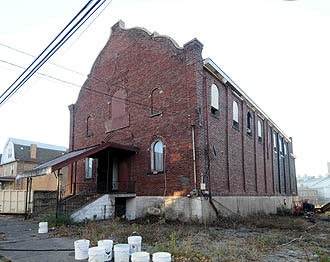
Saturday, November 06, 2010By Marylynne Pitz, Pittsburgh Post-GazetteBy next summer, Madonna del Castello Church in Swissvale will be transformed into four condominiums.
Located at 7416 Duquesne Ave., the former Roman Catholic church has been empty for the last five years, said Patrick Shattuck, senior real estate developer for the Mon Valley Initiative.
Mt. Zion Fire Baptized Holiness Church of God of America purchased the church from the Diocese of Pittsburgh in 1987 for $55,000. About five years ago, the congregation moved out, Mr. Shattuck said. In September, Mon Valley Initiative purchased the property for $10,000.
The church has a front Flemish-style gable, a barrel-vaulted ceiling and a large dome over the altar; all of these elements will be incorporated into the redesign.
“The space will certainly be dramatic with the high, barrel-vaulted ceilings. The altar will become a dining room with the dome over it,” Mr. Shattuck said.

Inside the church. Bob Donaldson/Post-Gazette
The building has been reconfigured by Lami Grubb Architects; renovations will be done by Mistick Construction. The building has stood empty and open to the elements, sustaining major water damage.
“The congregation that took it over actually put a dropped ceiling in. They were unaware that the water damage was substantial. So, they repaired the roof but a good portion of the plaster ceiling fell onto the dropped ceiling. That was when they were forced to move out,” Mr. Shattuck said.
The plaster was actually helping to hold the building together, he said. When structural engineers examined the building, they found gaps between the walls.
“You can see daylight between the front wall and the side walls,” Mr. Shattuck said.
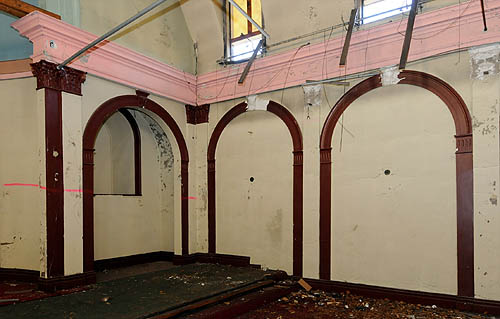
Another view inside the church. Bob Donaldson/Post-Gazette
Three of the new units will have 1,600 square feet, two bedrooms and 1 1/2 baths and be priced at $85,000. The fourth unit, which incorporates the dome over the altar, will have three bedrooms, 2 1/2 baths, a study and 2,400 square feet of space. It will cost $105,000.
Asbestos has been removed and the red brick exterior is being cleaned. Cast plaster moldings, six Corinthian capitals and arches in the church will be recast and incorporated into the design. The church sits on a quarter of an acre and there will be off-street parking for residents.
“We own a double adjacent lot next to it. There were two buildings that we had to demolish. It may be that we develop a single new house on the site or it may be that it becomes a community garden space,” Mr. Shattuck said.
-
Exhibit Celebrates the Many Styles of Homes in Beaver
Saturday, November 06, 2010By Marylynne Pitz, Pittsburgh Post-Gazette
A model replica of the Agnew-Anderson House, built in 1808, is among the exhibits in "Bricks, Mortar and Charm," an exhibition at the Beaver Area Heritage Museum. Bob Donaldson / Post-Gazette
BEAVER — Since 1802, this town 35 miles northwest of Pittsburgh has reflected the aspirations of the bankers, doctors, teachers, lawyers and politicians who inhabit its quaint streets and River Road, a lovely stretch of beautiful homes that overlooks the Ohio River.
Now, this community’s architectural aspirations are on view in a concise exhibition called “Two Hundred Years of Bricks, Mortar & Charm” at the Beaver Area Heritage Museum in downtown Beaver.
Local historians believe that a house built in 1805 and still standing at River Road and Market Street is the town’s oldest structure. Part of the home’s front section was built with hand-hewn logs that are still visible in the basement. The logs may have been salvaged from Fort McIntosh, a Revolutionary War structure built in 1778.
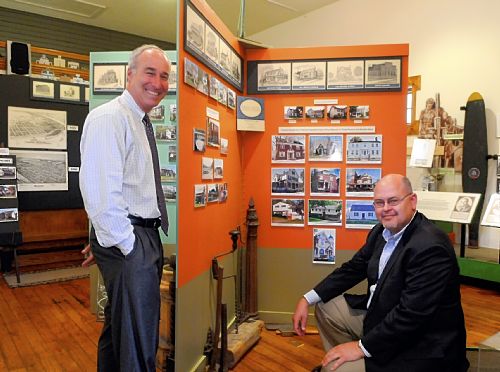
Edwards McLaughlin, left, and Mark Miner of the Beaver Area Heritage Museum take a look at "Bricks, Mortar and Charm," an exhibition that documents the architecture of Beaver. Bob Donaldson / Post-Gazette
Edwards McLaughlin, chairman of the museum’s board of trustees, spent weeks photographing homes all over Beaver for the exhibition, which examines the evolution of design styles in 50-year periods. His volunteer work correlates to his day job because he’s a partner in the real estate firm Bovard Anderson and a fourth-generation owner of the business.
With its 19th-century-style street lights and restored storefronts, Beaver retains its Victorian-era look. So it’s no surprise that from 1850 to 1900, plenty of Colonial Revival, Queen Anne and other Victorian-period homes were built. There’s also a smattering of Italianate, Gothic Revival and Romanesque homes.
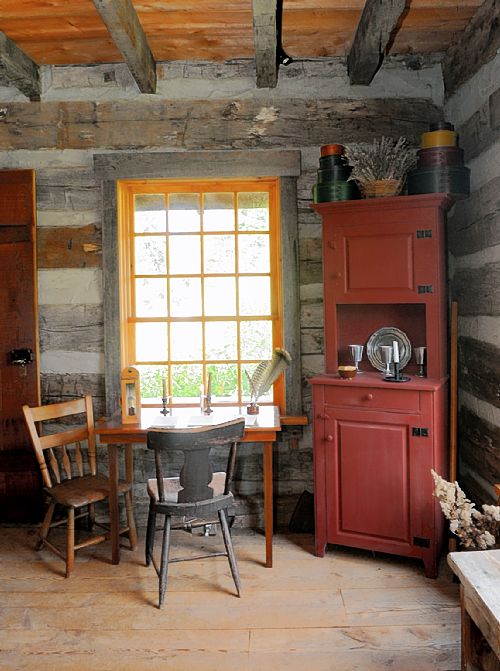
A replica log cabin is part of the Beaver Area Heritage Museum's permanent exhibit. Bob Donaldson / Post-Gazette
Surveyor Daniel Leet laid out Beaver, creating four squares in the center of town and four at its edge. Each one is named for a prominent resident or military leader. Agnew Square, for example, is named for Daniel Agnew, who was chief justice of the Pennsylvania Supreme Court. At Third Street and College Avenue, an exact replica of the clock tower that adorned the 1877 courthouse stands on the southeast corner.
A new century dawned and tastes changed between 1900 and 1950. As a result, Beaver has examples of English Tudor, Craftsman bungalows and Art Deco designs. There are even examples of Prairie-style homes, a Frank Lloyd Wright design ideal that emphasizes an open floor plan, horizontal lines, shallow roofs with broad overhangs and banks of casement windows with art glass.
The exhibition features an excellent model of Beaver’s 1877 courthouse plus a replica of the Agnew Anderson House. Both were made by Robert A. Smith.
Mr. McLaughlin is just one of several hundred volunteers who combined their collective, considerable elbow grease to transform a former Pennsylvania & Lake Erie Railroad freight house into the Beaver Area Heritage Museum 12 years ago. The building was a shambles with holes in the ceiling, thick grime on the floors and a basement packed with old dust.
Now, the museum sparkles. There’s a permanent exhibition about the Beaver region, an outdoor vegetable and herb garden with native plants and an 1802 log house that’s a replica of a frontier home.
Mildred “Midge” Sefton, a retired home economics teacher, oversees the volunteers, who meet regularly on Thursday mornings in the basement to accession, catalog and log onto a database each artifact and document that is donated to the museum. Judy Reiners of Beaver recently finished compiling family documents that belonged to Adolf Mulheim, proprietor of a wallpaper and carpet store from around 1880 to the 1930s.