Category Archive: City Living
-
Carlynton Votes to Consolidate Elementary Schools
Friday, February 18, 2011By Kim LawrenceThe Carlynton school board voted 5-4 Thursday night to close Crafton and Carnegie Elementary Schools and build a new school at the site of the existing Carnegie Elementary School.
The decision came after about two hours of listening to Crafton parents discuss the devastation that would occur if they lost their neighborhood elementary school. Carnegie council members said they would welcome a consolidated school in their neighborhood.
School board President Thomas W. Brown, Vice President Patty Schirripa, Sandra Hughan, Ronald McCartney, and Thomas Di Pietro voted for this consolidation. Board members Nyra Schell, Betsy Tassaro, Sharon Wilson and Raymond Walkowiak dissented. Mr. McCartney made the motion to build a new elementary school at the Carnegie site to accomodate all of the children in the district. Director DiPietro seconded the motion.
The details have yet to emerge regarding where the students will go when their school is torn down. Mr. McCartney said that the Carnegie athletic field would remain intact.
-
Water to Blame for Wall Collapse
Tuesday, February 15, 2011By Diana Nelson Jones, Pittsburgh Post-Gazette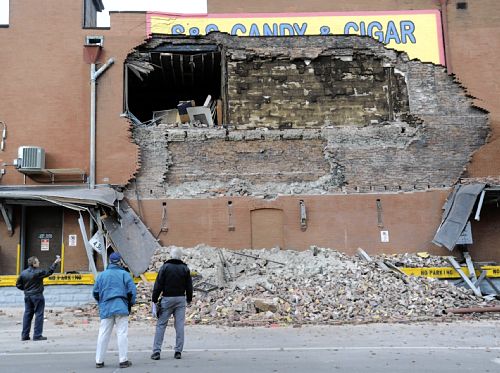
Pittsburgh building inspectors examine the partial collapse of a brick wall at S&S Candy and Cigar Co. at South 21st and East Carson streets on the South Side Monday morning. Bob Donaldson/Post-Gazette
Bricks and mortar rained onto 21st Street Monday morning, the likely result of water damage to the side of the S&S Candy and Cigar Co. at 2025 E. Carson St. on the South Side.
No one was injured.
An almost identical incident occurred in the morning when bricks fell from the side of a dentist’s office in Washington, Pa., damaging four cars.
Bob Farrow, division chief of Pittsburgh’s EMS department, said the outer layer of bricks on the S&S building gave out, followed by a crashing down of older bricks and mortar behind it.
The owner was not available to discuss the damage, but acting Bureau of Building Inspection Chief John Jennings said he suspected that water got in behind the veneer of bricks and pushed them out.
“We have seen this before, where water seeps in behind the brick, freezes and pushes the bricks out,” he said.
A structural engineer will be called in, he said. “We need to shore up the floor joists because they are compromised, but the damage is just to this one side. This building can be saved.”
Police closed South 21st Street between East Carson and Sidney streets. The parking lane alongside the candy store was covered with rubble.
Dozens of bystanders stared as the outer layer that had not fallen hung peeled back like a rind.
The candy and tobacco store has been in business in Pittsburgh since 1965.
In Washington, the brick facade of the dentist’s office detached without warning onto a side street, crushing four cars in the building’s parking lot.
Strong winds are being blamed for the collapse, according to what building owner Thomas C. Drewitz heard from insurers.
Emergency workers cordoned off the two-story building in the 800 block of Jefferson Avenue after the 10:40 a.m. incident. The city issued an emergency demolition permit to remove any loose bricks that had not fallen.
“Everything started to rumble and shake,” Dr. Drewitz said. “It went down fast.”
Dr. Drewitz said the building was constructed around 1965.
Three cars were totaled and a fourth suffered heavy damage.
“They were flat,” fire Capt. Nick Blumer said of the vehicles.
Dr. Drewitz closed the office for the day but said he planned to reopen today.
-
Historic District Building’s Wall Collapses in South Side
By Margaret Harding
PITTSBURGH TRIBUNE-REVIEW
Tuesday, February 15, 2011Historic District Building’s Wall Collapses in South Side
Francine Mykich was preparing S&S Candy and Cigar Co. for its busiest day of the week when she thought she heard a truck hit the South Side store.
“We came in just like a normal Monday morning, and then all of a sudden ka-boom,” said Mykich, who has worked at the business on East Carson and South 21st streets for 26 years. “We came outside, and it’s been steadily crumbling.”
A wall of the building, which dates to 1892, collapsed onto 21st Street about 8:40 a.m. Rubble covered the sidewalk and part of the street. All the employees safely evacuated the building, and no one was injured.
“The time of day was very fortunate,” Mykich said. “We weren’t open yet, thank God.”
The collapse likely was caused by moisture freezing between layers of brick and breaking the bonds between them, said John Jennings, the city’s interim building inspection director. When the bricks thaw, there’s nothing left holding them together, he said.
The owner of the building, identified in property records as Richard Stephens, has to get an engineer to stabilize the building before clean-up begins, Jennings said. Bricks and pieces of the building continued to fall throughout the morning. Through employees, Stephens declined to comment.
It could take a day or more to stabilize the building, Jennings said.
The building is part of the East Carson Historic District. It first appeared as Armour & Company Wholesale Meats in 1892, said Frank Stroker, assistant archivist with Pittsburgh History & Landmarks Foundation.
“It was probably their main facility at that point,” Stroker said.
Armour held the location until 1952. The building then briefly became home of Freezer Foods Inc., Stroker said. By 1956, Brinn’s China and Glassware moved in, he said, and held the spot until S&S took over in 1965.
City officials would have to approve any demolition, alterations or repairs because of its location in the historic district, said John Martine, an architect and member of the local advisory committee to the city’s Historic Review Commission.
Martine said he’s always admired a canopy along the side of the building. The collapse destroyed the canopy.
“It was a very simple, but interesting canopy with wonderful wood brackets that went the length of the loading docks,” Martine said. “It’s a very working-type building. It’s not that fancy, but there’s enough detail there that it would be a loss to see the building go.”
-
Market Square Shines with Jos. A. Bank and Crazy Diamonds
Pop City
Wednesday, February 09, 2011
Market Square Shines with Jos. A. Bank and Crazy Diamonds
This spring, mens’ clothing store Jos. A. Bank will be moving from its current Downtown location at 527 Smithfield Street to Market Square. Another recent Market Square development includes the upcoming installation of a beautiful work of public art.
Jos. A. Bank signed a deal with developer Millcraft Industries at the beginning of February to lease space in the 40,000-square-foot Market Square Place development, located in the former G.C. Murphy building. Herky Pollock of CB Richard Ellis represented Millcraft Industries in the deal. Jos. A. Bank will share ground floor retail space in Market Square Place with the recent additions of Liberty Travel, DiBella’s Old Fashioned Submarines, Chipotle, and Vallozi’s.
“This relocation, which will feature the Jos. A. Bank’s new prototypical layout and design, further validates the success of our vibrant central district and all the new energy that has been harnessed with the new development project in the corridor,” says Pollock.
Keep your head up when entering Market Square from Fifth Avenue this spring as artist Carin Mincemoyer’s light sculpture “Diamond, Diamonds” will soon be hanging around. The piece entails the installation of 80 glass “diamonds” lit with LED lights and hung from two poles–a nod to the public space known as The Diamond, which was located at the Market Square site until it was demolished in 1961. Mincemoyer won a design competition to illuminate the connection between the square and the Cultural District after the City’s Office of Public Art put out a call for proposals.
Sources: Herky Pollock, executive vice president of CB Richard Ellis
Hollie Geitner, vice president of marketing and communications for the Pittsburgh Downtown Partnership -
Around Town: Point of Realism Interferes With Preserving Arena
Tuesday, February 08, 2011By Brian O’Neill, Pittsburgh Post-GazetteAround Town: Point of Realism Interferes With Preserving Arena
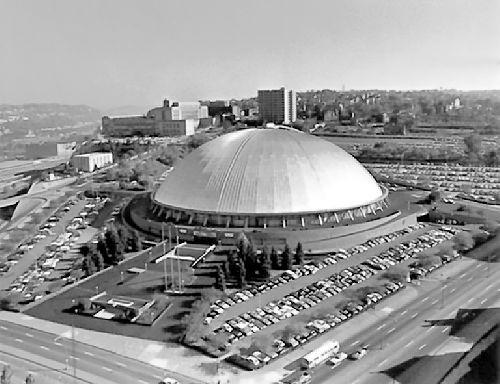
An architectural superstar of its time. And now?
The Civic Arena can still pack ’em in. It was standing-room-only last week at the Pittsburgh Historic Review Commission meeting on Ross Street, just down the hill from the vacated hockey palace.
Some very smart people made a polished and impassioned presentation that showed the 49-year-old Igloo to be an architectural superstar, an engineering marvel and the symbol of Pittsburgh’s Renaissance, rising just as the city’s skies were clearing.
What nobody offered, though, is what practical use it has now. In the past quarter-century, three multipurpose arenas of ascending size — the 5,400-seat Palumbo Center, the 12,500-seat Petersen Events Center and the 19,000-seat Consol Energy Center — have been built within two miles of the place.
This city needs another arena like it needs a hole in the Hill.
To be fair, it wasn’t the job of preservationists this day to offer a practical new use for the empty building. The question was whether the Civic Arena should be designated a historic structure.
But if the commission votes next month to grant historic designation (preliminary approval last month is no guarantee), that would prevent the city-county Sports & Exhibition Authority from demolishing the arena. That would muck up the Penguins’ development plans for the 28-acre site, and the most prominent Hill District leaders don’t want those plans blocked. Residents have been waiting 50 years to get their neighborhood back.
Both preservationists and those who want to see office buildings, stores and about 1,200 new homes built at the site agree on one thing: The way the Hill District was treated when the arena site was cleared in the 1950s was a civic crime. About 1,300 buildings, 400 businesses and 8,000 lower Hill residents got the heave-ho. Promises of better housing were never kept, and the highway ditches and largest park-for-pay lot in Western Pennsylvania are the neighborhood amputation scars.
Rob Pfaffmann, the Downtown architect who has spearheaded the Reuse the Igloo campaign, suggests that keeping the building can help future generations remember that painful history. He quoted the native son who did the most to celebrate the neighborhood, the late playwright August Wilson, who said, “My plays insist that we should not forget or toss away our history.”
Mr. Pfaffmann even broke out a Rick Sebak video on the arena. (The video player, like the Igloo’s acoustics, went awry shortly.) But neither Mr. Pfaffmann nor the city’s premier architectural storyteller, Franklin Toker, could persuade Hill leaders that this mammoth steel assemblage would be anything but a humongous kink in plans to reknit the neighborhood into Downtown.
City Councilman Dan Lavelle said the commission’s mission statement also speaks to the preservation of neighborhoods. He hoped it would pay attention to community residents rather than those with fond memories of coming to the lower Hill “to listen to the Beach Boys at the expense of those who lived there.”
This “case study of urban renewal gone wrong,” which isolated and divided the Hill, is “not the sort of history we wish to preserve,” Mr. Lavelle said. Preserving it, he said, would be like flying Confederate flags on state buildings in the South.
Paying $50,000 a month to maintain it, or tens of millions of dollars to modify it for a new use, would not be a smart move for a strapped city, he concluded.
What do you do with a spare arena? Modification plans all seem a bit like getting a bear to ride a bicycle. It can be done, but that’s not really what either bears or bicycles are for.
What about saving part of it? TV actor David Conrad, in a videotaped presentation, said he understood why neighborhood residents want the arena erased, but saving a piece could “transform an insult into pride.” Preservation of a remnant would be akin to the iconic murals of saints, he said, which often show the martyred figures holding the very weapons that killed them.
Sala Udin, who formerly held the council seat in the Hill, didn’t think the neighborhood would oppose a “remnant that stayed as some kind of icon.” But full preservation would block development plans.
Penguins President David Morehouse said preserving a remnant, as was done with the Forbes Field outfield wall, is possible, but “you can’t have half of a dome in the middle of your development.”
The Hill’s comeback has to be the primary goal. That started more than 20 years with the hugely successful Crawford Square townhouse development just east of the arena. With gasoline prices soaring, building another 1,200 new homes in the heart of the region is about the best news a shrinking city could get.
-
The New Granada Theater is Granted National Historic Register Status!
February 5, 2011
New Granada Theater
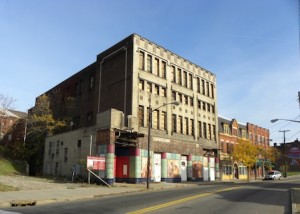
Congratulations to the Hill Community Development Corporation, the steward of the New Granada Theater historic preservation project. With the assistance of the Pittsburgh History and Landmarks Foundation, the New Granada Theater was granted National Historic Register Status by the National Parks Service on January 7, 2011!
Having been stabilized with the assistance of the State of Pennsylvania and The Heinz Endowments, we look forward to the long, fundraising road ahead to renovate this historic institution as a multi-use, sustainable facility that pays tribute to its former uses, including that of a theater, office space, skating rink and even a car show room!
-
Fate of Civic Arena Debated
Panel considering historic designation for Hill landmarkThursday, February 03, 2011By Mark Belko, Pittsburgh Post-Gazette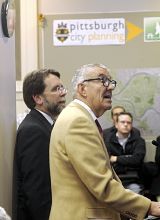
John Oyler, right, an engineer, talks Wednesday about how important the Civic Arena is as an example of structural engineering because it was done in the days before computer design. Speaking before the Historic Review Commission, he described how remarkable and unique the retractable dome is. Larry Roberts/Post-Gazette
To those who want to see it saved, the Civic Arena is an engineering marvel, an irreplaceable icon and a testament to Pittsburgh know-how.
But to those who want to see it go, the arena is “more a symbol of genocide” than a civic treasure, an aging relic with bad pipes, lousy acoustics and high maintenance costs.
So it went for more than four hours Wednesday during a public hearing before the Pittsburgh Historic Review Commission to determine whether the 49-year-old landmark should be designated as a city historic structure.
The commission, in a 5-1 vote last month, already gave preliminary approval to the designation, which would prevent the city-Allegheny Sports & Exhibition Authority from demolishing the building as part of a plan by the Pittsburgh Penguins to redevelop the site.
It is scheduled to take a final vote next month. Preliminary approval is no guarantee the arena will survive. In 2002, the panel gave similar approval to the designation only to reject it in a final vote.
Perhaps that’s the reason the nominator, Hill District resident Eloise McDonald, backed by Preservation Pittsburgh and Reuse the Igloo, and the SEA and the Penguins each spent more than an hour Wednesday advancing their arguments for or against designation.
Ms. McDonald and her allies believe the arena meets six of the 10 criteria that make a structure worthy of designation, including its location as a site for significant historic events, its exemplification of a rare, unique or innovative architectural style, and its unique location and distinctive physical appearance.
Only one of the 10 must be met to get a designation.
Franklin Toker, an architecture professor and the author of “Pittsburgh: A New Portrait,” argued that the arena “is, historically, the most representative building now standing in the city of Pittsburgh,” more so than the Cathedral of Learning, the county courthouse or the David L. Lawrence Convention Center.
He said the arena’s planning and construction “coincided exactly with the most exhilarating, most creative and most ambitious moment this city has ever known: the Pittsburgh renaissance.”
Others cited the arena’s retractable dome, one of the few in the world, or the engineering that made it work as reasons the old building should be saved.
Shawn Gallagher, the SEA’s attorney, said the agency doesn’t believe the arena meets even one of the 10 criteria for nomination.
He and others who support demolition said the arena requires millions of dollars in capital improvements, doesn’t meet accessibility standards and has no viable future as an entertainment venue.
“It clearly is not worthy of preservation,” Mr. Gallagher said.
City Councilman R. Daniel Lavelle said the arena, for many in the Hill, represents failed public policy, one that destroyed homes and businesses and displaced thousands of residents.
“This is not the sort of history we wish to preserve,” he said.
The hearing drew a number of other Hill residents who made similar comments, including former city Councilman Sala Udin, who said the arena is “more a symbol of genocide than a historic icon.”
And while some remember favorite concerts or exciting hockey games when they go into the arena, Hill resident Angela Howze recalls something else.
“Every time I go in there I remember it once was my grandmother’s house,” she said.
-
Children’s Museum Has Bulk of Funds to Build Park
Friday, January 21, 2011By Diana Nelson Jones, Pittsburgh Post-GazetteThe Children’s Museum is $2.2 million away from raising the funds it needs to transform the sunken concrete square outside its doors into the Allegheny Public Square Park and make upgrades inside the museum.
Officials Thursday announced they had raised $6.3 million of the $8.5 million needed and that the remainder would be solicited as public donations.
The bulk of the money to date has come from foundations. A $250,000 challenge grant from the Buhl Foundation will match $1 for every $2 contributed by the public.
The existing square was created in the 1960s as part of the Allegheny Center Mall. A sunken area housed a fountain encircled by amphitheater-like seating. The area now is a walk-through zone, sometimes used by skateboarders but otherwise ghostly.
The museum chose San Francisco landscape architect Andrea Cochran in a design competition in 2007, when it embarked on its capital campaign. Ms. Cochran’s design for the new park calls for native plants, a meadow, 75 additional trees, solar lighting, a rain garden and a V-shaped walkway with benches and movable seats and tables.
The park’s art feature will be a stainless steel sculpture by Ned Kahn. Called “Cloud Arbor,” the piece will stand as rows of stainless steel tubes with nozzles to create “a sphere of mist,” said museum executive director Jane Werner. “It is a companion to our wind sculpture,” called “Articulated Cloud,” which Mr. Kahn also designed as 43 panels on the building that create the illusion that the building is moving with the wind.
A north-to-south row of cypress trees along Children’s Way will be kept while about 10 others will be replaced, said Ms. Cochran, adding that arborists had determined them to be unhealthy.
Plants have been chosen for their contributions to green design, she said. “We are teaching by example, with plants that don’t need pesticides or fertilizers.”
“Everything we all say we care about — the environment, green space and kids — all comes together here,” said state Sen. John Pippy, R-Moon, a museum board member.
The project’s budget will also cover alterations of the museum’s nursery, store and cafe.
“We are hoping to break ground sometime this year,” said Ms. Werner. The project may be completed next year.