Category Archive: Neighborhood Development
-
Allegheny Grows Funds First-Year Projects in Wilkinsburg, Bellevue and Penn Hills
Thursday, February 10, 2011By Len Barcousky, Pittsburgh Post-GazetteAllegheny Grows Funds First-Year Projects in Wilkinsburg, Bellevue and Penn Hills“Allegheny Grows” is itself growing with urban-agriculture projects spreading to three more communities.Allegheny County Executive Dan Onorato will announce today that Bellevue, Wilkinsburg and Penn Hills will be the sites this spring of new urban farms and community gardens.
This year is the second for the program designed to dress up empty lots, build community spirit, encourage local organizing, aid the environment and provide fresh produce for local food pantries.
“Allegheny Grows builds on the county’s ongoing initiatives to revitalize older communities and distressed municipalities through sustainable development and strategic investment,” Mr. Onorato said in a statement.
A dozen communities competed to participate in this year’s program.
The three that were chosen were selected for their strong leadership, enthusiasm of local volunteers, suitability of their garden site and community need, project manager Iris Whitworth said. She works for the business development unit of the county’s economic development office.
Allegheny Grows has a budget this year of about $75,000. In addition to setting up the three new agricultural projects, the funds will be used to cover second-year costs for garden projects begun last year in Millvale and McKees Rocks. The source of the money is federal community development block grants.
The effort is a collaboration with Grow Pittsburgh and local partners in each community. Grow Pittsburgh was formed in 2005 to encourage city gardening.
Bellevue’s project will be a urban farm on Davis Avenue on a 1-acre vacant tract owned by North Hills Community Outreach. The land had been donated in 2008 to the social-service agency by the Amelio family for an organic garden, according to Fay Morgan, executive director of North Hills Community Outreach.
North Hills Community Outreach is a faith-based social-service agency that serves families and individuals in communities north of Pittsburgh. Most of the labor for the organic farming effort will be provided by volunteers, supervised by a part-time agency employee. Produce grown there will be donated to food pantries.
Wilkinsburg’s urban farm is a 2-acre site in the city’s Hamnett Place neighborhood. The land is owned by Pittsburgh History and Landmarks Foundation, which already is involved with several housing renewal projects in the community. Allegheny Grows will be working with a citizens organization called Hamnett Place Community Garden Association to plant and care for the site.
Penn Hills officials are providing a water truck and leaf-mulch compost for a community garden on the site of a former municipal ballfield. The tract had been planted as a garden last year by a youth group. Produce grown through this year’s effort will benefit up to three local food pantries.
Second-year Allegheny Grows’ assistance to gardens in Millvale and McKees Rocks will include providing both seedlings and some technical advice from Grow Pittsburgh. Millvale also will receive several rain-collecting barrels and McKees Rocks will get help in edging its garden beds and making them accessible to people with disabilities.
-
Deal Reached to Save Historic Franklin County House
Tuesday, February 08, 2011By Len Barcousky, Pittsburgh Post-GazetteDeal Reached to Save Historic Franklin County House
A history-loving physician has worked out a deal to save an 18th century home in Mercersburg.
Dr. Paul Orange said today the William Smith House will be taken apart piece by piece over the next several weeks and reassembled on a new site elsewhere in the Franklin County community.
The future of the building has been in question since the structure and land on which it stands were acquired two years ago by a local volunteer fire company. The MMP&W Fire Co., which has its headquarters and garages next door to the house on Main Street, bought the property for expansion and had announced plans to demolish the building.
That news resulted in the creation of a citizens group, the Committee to Save the Justice William Smith House. Members say that events planned in the stone Ulster-style cottage in 1765 resulted in the earliest opposition to British rule in the American colonies and laid the groundwork for the Second Amendment to the U.S. Constitution. That amendment guarantees the right to bear arms.
Dr. Orange, who has a family medical practice outside Chambersburg, estimated that the relocation project will cost as much as $250,000. He has agreed to fund at least $50,000 of that amount.
The first steps involve removing 19th- and 20-century additions to the structure, carefully taking apart and numbering stones and timbers from the core of the building and arranging for storage nearby. That process is likely to take several weeks, he said.
No decision has been made on where the house will be rebuilt. Several suitable properties are vacant along and near the borough’s Main Street.
Mercersburg is about 150 miles southeast of Pittsburgh.
-
Civic Arena a ‘Symbol of Genocide’
By Bill Vidonic
PITTSBURGH TRIBUNE-REVIEW
Thursday, February 3, 2011Former City Councilman Sala Udin was among the 8,000 residents and businesses in the lower Hill District who were displaced in the 1950s for construction of the Civic Arena.
On Wednesday, he urged Pittsburgh’s Historic Review Commission to reject a push to grant the arena protection under the city’s historic structure preservation law.
“This is more a symbol of genocide than a historic icon,” Udin said. “Demolish the arena and let the promise begin.”
During more than four hours of testimony, preservationists said that the arena’s distinct domed shape, its engineering and its place in the fabric of Pittsburgh’s history should spare it from a wrecking ball.
The city-county Sports and Exhibition Authority, which owns the building, and city Planning Commission have voted to demolish the building. The SEA had hoped to start in April, but the nomination for historic status has delayed that.
“There’s nothing like it anywhere else,” said Eloise McDonald of the Hill District, one of the people who nominated the structure in November. “That’s what makes it historical.”
Franklin Toker, a University of Pittsburgh art and architecture professor, said development and construction of the arena in the 1950s and ’60s coincided with “the most exhilarating, most creative and most ambitious moment this city has ever known: the Pittsburgh Renaissance.”
“It is the branding image for Pittsburgh, right under our noses,” Toker said.
A 2007 agreement between the Sports and Exhibition Authority and the Pittsburgh Penguins gave the sports franchise development rights for the 28-acre site.
Various representatives outlined a long-term redevelopment plan — one in which the arena is leveled — to make way for residential, retail and commercial development, creating thousands of jobs and millions of dollars in tax revenue.
City Councilman R. Daniel Lavelle, who represents the Hill District, said there’s no redevelopment plan for the arena itself.
“The hard truth is that the Civic Arena remains a symbol of failed public policy and a continual deterrence to economic viablility for the Hill District community. Historic designation and preservation, for many reasons, is not the correct decision. On the contrary, what might be more appropriate at this time is an apology for the historic injustices that were heaped upon the Hill District when it was torn asunder nearly a half-century ago.”
The city rejected historic status for the structure in 2002. The Historic Review Commission could make a recommendation next month; the city’s Planning Commission and City Council still must consider the request, a process that likely will stretch into summer.
-
Iron City Allowed to Raze Building
By Bill Vidonic
PITTSBURGH TRIBUNE-REVIEW
Thursday, February 3, 2011The city’s Historic Review Commission will allow the president of Iron City Brewing Co. to tear down a dilapidated building at its former Lawrenceville production site.
The commission on Wednesday said Tim Hickman should provide it with photographs and other documentation of the 1,900-square-foot building for its records, but otherwise can proceed.
The city’s Bureau of Building Inspection cited the brewing company because of the distressed state of the building, but the site’s historic status — granted by the city last year — had complicated the issue of razing the building.
Commission acting chairman Ernie Hogan said state officials indicated that tearing down the former pipe shop shouldn’t interfere with the historic status or development tax credits. Hickman said the site could be developed for light industrial use and industrial warehousing.
Iron City moved production from Lawrenceville to Latrobe in 2009.
Hickman will have to talk to the commission next month about taking fermentation tanks out of another building. Hickman proposed removing two walls to do so; he said the building is useless with the tanks inside.
Also, Hickman has an agreement with the Pittsburgh Water and Sewer Authority to use the proceeds of the tanks’ sale to settle a billing dispute dating to 2007.
-
Row of Vacant Lawrenceville Houses Being Restored with Historic Exteriors, Custom Interiors
Wednesday, February 02, 2011
Pop City Media
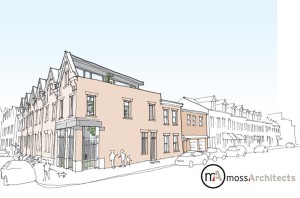
19th Century Row Houses in Lawrenceville
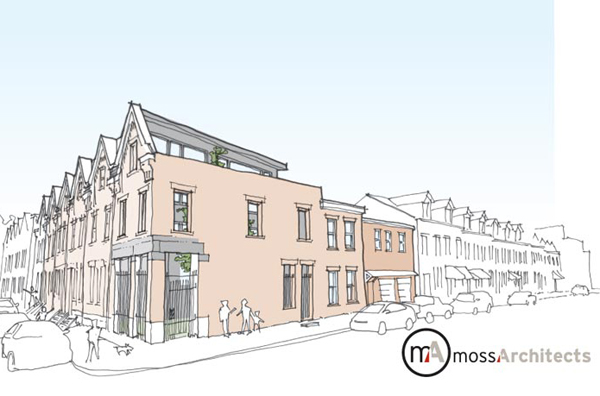
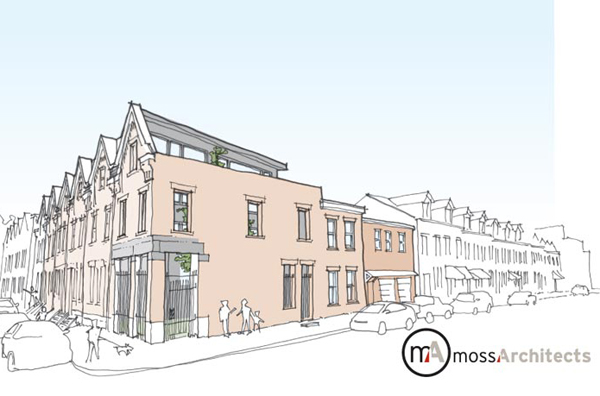
Since they were left vacant in 1995, the row of five historic brick houses on 48th Street, between Hatfield and Butler Streets, in Lawrenceville have fallen into terrible shape. With creative design and green construction, the homes are being restored to look the way they would have when they were built in the 19th century, but with customized modern interiors.
The City of Pittsburgh acquired the buildings, with the help of the Lawrenceville Corporation, in 2007 at very low cost using a tax lien process. After receiving proposals from many eager developers, the Lawrenceville Corporation closed on the sale last week with Botero Development, who’s principal Brian Mendelssohn lives in the neighborhood.
“They’re going to be a high quality product. We’re going to restore the exteriors using real materials, meaning real stone and real slate, and install stone steps and things like that to make them look like when they were built,” says Mendelssohn, who is working with Moss Architects on the project. The interiors will be custom-built for the aesthetic whims of the individual buyers, blending historic elements and original materials with modern features, such as stainless steel appliances, and energy efficient design aspects, like a 2-inch white rubber roof.
The homes, which are currently for sale, include four 1900-square-foot, 3-bedroom units with rear yards. Two come with 2.5-baths and the other two have 2-baths. One 1,250-square-foot unit has 2-bedrooms and 2-baths. The houses will be completed by next October and are priced between $180,000 and $265,000. A sixth building was beyond repair, but its lot will serve as a private courtyard for the $265,000 unit.
“I feel the prices are below market value for what these buildings are,” says Mendelssohn. “It will be good for the neighborhood not to start charging $300,000 for homes in Lawrenceville. You don’t want to gentrify your own neighborhood, you want to keep it what it is.”
Writer: John Farley
Source: Brian MendelssohnImage courtesy of Botero Development
-
$10 Million PHLF Redevelopment Projects Restore Three Homes and Create 27 Apartments in Wilkinsburg
Wednesday, February 02, 2011
Pop City Media
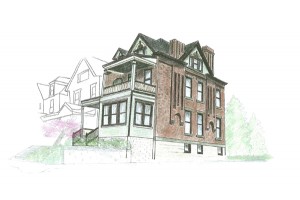
Pittsburgh History & Landmarks Foundation - Wilkinsburg Redevelopment
When Pop City last reported on The Pittsburgh History and Landmarks Foundation‘s Wilkinsburg redevelopment projects in 2008, four homes in the Hamnett Place neighborhood had successfully been restored. The PHLF recently announced that three more historic Hamnett Place houses, as well as the two-building, 27-unit Crescent Apartment development, are scheduled for completion by fall of 2011.
“It really is one big project because all of these things are kind of interlinked. We also launched a housing resource center in the same area last year and we’ve done a lot of cleaning and vacant lot work around the area. There are a lot of initiatives happening right now in Wilkinsburg that total over $10 million,” says Michael Sriprasert, director of real estate for the PHLF.
“Right now the three properties at 833 and 845 Holland Avenue and 517 Jeanette Street have undergone interior demolition and we have begun construction,” says David Farkas, director of main street programs for the PHLF, in regard to the second phase of the Hamnett Place project that began in December. The PHLF received assistance from Allegheny County Economic Development and The Allegheny Foundation for the restoration of these homes, which will have buyer incomes restricted to 120% of the area median income.
The PHLF is 30% finished with the redevelopment of two buildings in the $8.6 million, 27-unit affordable Crescent Apartments, which was funded by The Pennsylvania Housing Finance Agency, Allegheny County’s Office of Behavioral Health, and private sources.
The PHLF worked with architects Landmarks Design Associates on both the Hamnett Place and Crescent Apartments projects, and with Mistick Construction and Sota Construction on the Hamnett Place and Crescent Apartments, respectively.
Writer: John Farley
Sources: Michael Sriprasert and David Farkas, PHLFImage courtesy of PHLF
-
Landmarks Foundation Waits for Word on $4 Million State Grant
By Craig Smith
PITTSBURGH TRIBUNE-REVIEW
Wednesday, February 2, 2011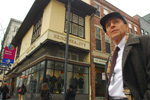
Arthur Ziegler, president of the Pittsburgh History & Landmarks Foundation, surveys Fifth Avenue, Downtown, part of an area his group has earmarked for more redevelopment like its Market at Fifth project. The foundation is awaiting word on whether a $4 million state grant from former Gov. Ed Rendell's administration will come through. Gov. Tom Corbett is reviewing that grant and others like it. Keith Hodan | Tribune-Review
Arthur Ziegler Jr. likes what he sees Downtown.
Seven apartments and two retailers occupy three historic buildings that were brought back to life through a $3 million Pittsburgh History & Landmarks Foundation project dubbed Market at Fifth. More projects in the area could come to fruition if a $4 million state grant comes through.
“I am very pleased … the momentum is gaining,” said Ziegler, the foundation’s president.
Ziegler hopes to leverage the $4 million grant from former Gov. Ed Rendell to do more historic renovation work. Gov. Tom Corbett, who took office last month, is reviewing the grants, handed out in the final days of the Rendell administration through the state’s Redevelopment Assistance Capital Program, or RCAP.
The money was committed to Pittsburgh for historic building facade and core shell restoration, Ziegler said. The city appointed the landmarks foundation to carry out the work.
“It would be a great project for the city and Downtown,” said Rob Stephany, executive director of the city Urban Redevelopment Authority.
Some leaders criticized Rendell’s use of the RCAP grants, which come from borrowed money. Corbett said before he took office he would review all of the grants Rendell approved at the end of his term.
“We’re trying to go through the RCAPs as quickly as possible to make a decision,” said Kevin Harley, spokesman for Corbett.
Other areas of the country are successfully using historic renovation to spur development.
“We’re seeing a real move back to our center city — businesses and residents,” said Kevin Schwab, vice president of communications for CenterState Corp. for Economic Opportunity in Syracuse, N.Y.
Since the late 1980s, the downtown population has doubled from 1,000 to 2,000 people and 16 of 18 condos near a historic district have been sold, Schwab said. In the past decade, the revitalization has gained momentum, even during the recession, he added.
“It has all been driven by the rehabilitation of buildings that have been deemed historic,” he said.
New buildings are going up “with an eye toward being in concert” with what is already around them, he said.
If the $4 million grant for Pittsburgh survives Corbett’s review, the landmarks foundation plans to augment it with donated funds “so we can really solidify the new quality retailing we introduced with Market at Fifth,” Ziegler said.
“We would like to double (the $4 million),” he said.
The money would be used to renovate a half-dozen historic buildings scattered in the Fifth and Forbes area that have been scheduled for preservation since the days of former Mayor Tom Murphy, Ziegler said.
The Market at Fifth project restored three buildings within the Market Square historic district, including the former Regal Shoe Co., which opened in 1908.
The Regal building was designed by Alden & Harlow, then one of the city’s prominent architectural firms, responsible for the Carnegie Institute and Library additions in Oakland, and Carnegie branch libraries in various communities.
Its chief designer was one of the firm’s principals, Frank E. Alden, who in the late 1800s worked with architect H.H. Richardson supervising construction of noteworthy Downtown buildings such as the Allegheny County Courthouse and the Allegheny County Jail.
-
Historic Swissvale Church Receives Second Life as Condominium Development
John Farley, Pop City Media
Wednesday, January 26, 2011
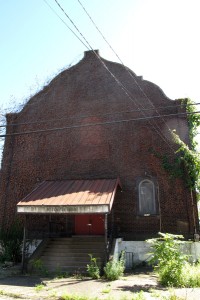
Madonna del Castello Church, 7416 Duquesne Avenue, Swissvale.
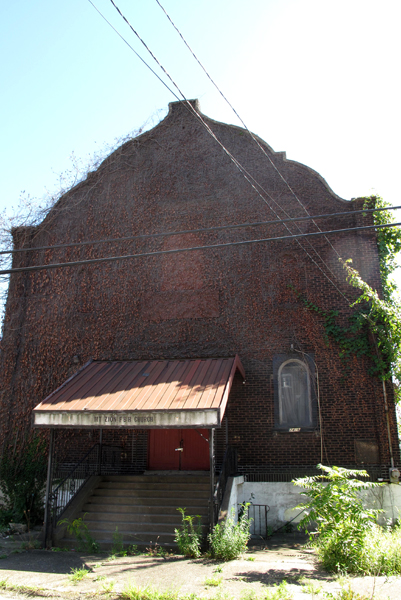
The Madonna del Castello Church at 7416 Duquesne Avenue in Swissvale has sat vacant for five years since its congregation left, leaving the unique brick building to fall into considerable disrepair. The church will experience new life as (a) condominium complex thanks to a partnership between the community, The Mon Valley Initiative, and the Swissvale Economic Development Corporation, who have begun construction that will incorporate many of the church’s original architectural features into the redesign.
“Its reuse as a church wasn’t going to be feasible so we looked at other options to maintain this part of the neighborhood,” says Patrick Shattuck, senior real estate developer for The Mon Valley Initiative, who purchased the property last September for $10,000.
Working with plans by Lami Grubb Architects, Mistick Construction is currently installing structural steel supports and expects the project to be completed by late spring or early summer. The plaster moldings and original arches will stay, becoming part of the new townhouse-style condos.
Three of the four condos will be 1,600-square-foot, two-bedroom, one-and-a-half-bathroom units. The fourth condo will be a 2,400-square-foot, three-bedroom, two-and-a-half-bathroom unit, which will feature the large dome that is currently over the altar as part of the space. The condos will range in price between $80,000 to $105,000.
A former rectory and convent next door to the church had to be demolished but the vacant lot where they once stood will soon be put to good use. “We had hoped to renovate the buildings, but ultimately they proved to be too far gone. It is a buildable lot, so whether we include that in the future phase for a house or whether we leave it for public green space will be determined,” says Shattuck.
Writer: John Farley
Source: Patrick Shattuck, The Mon Valley InitiativeImage courtesy of The Mon Valley Initiative