
Category Archive: Education
-
Historic Crafton Elementary School Threatened with Closure
PHLF News
January 28, 2011In 2010, the Carlynton School District conducted a district-wide facilities-use study on renovating or replacing its two elementary schools: the Carnegie Elementary School and the Crafton Elementary School.
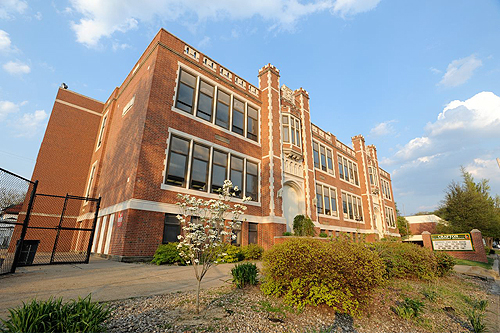
The Crafton Elementary School, built in 1913 and designed by architect Press C. Dowler, is a handsome Tudor-style building located at 1874 Crafton Blvd, a lovely residential neighborhood of Crafton Borough. The school is threatened with closure and ultimate abandonment in one of the options being considered.
Included in the Pennsylvania Historical and Museum Commission Architectural Survey of Historic Resources, the building has served as a community focal point for nearly a century and was one of the deciding criteria in selecting Crafton as the best place to raise children in Pennsylvania by Bloomberg BusinessWeek. The Crafton Elementary School is made of hand-burned brick laid in Flemish bond and has two projecting bays with crenelated tower projections, giving the building a stately appearance.
Crafton Councilwoman April Weitzel called the building a “gem of the community that has served and will continue to serve the citizens of Crafton and Carnegie.” Councilwoman Weitzel is convinced that renovating the school will be less expensive, resulting in no tax increases for the district. She further stated that “maintaining our neighborhood schools instead of abandoning them helps stabilize property values and encourages others to move into Carnegie and Crafton.”
Pittsburgh History & Landmarks Foundation would like to see this building continue being used as a school and has expressed its concern about possible closure of this important community asset. Renovation of historic schools is often less expensive than new construction. Restoration supports “green” policy and helps stabilize historic neighborhoods. This issue is scheduled to be discussed at the next School Board meeting. Comments can be sent to:
Carlynton School District
435 Kings Highway
Carnegie PA 15106
Click for MapBoard Meeting: Thursday, February 3, 2011 at 7:00 p.m. in the High School Cafeteria
and
Board Meeting: Thursday, February 17, 2011 at 7:30 p.m. in the High School Cafeteria -
Kaufmann’s is Back? Well, the Kaufmann Center will be, with $100,000 from PPG
Wednesday, January 05, 2011
Pop City Media
The historic Kaufmann Center in the Hill District, home to social services and events in the neighborhood for decades, is that much closer to reopening as a state-of-the-art auditorium for community development, education, arts and cultural happenings, thanks to a $100,000 grant from the PPG Industries Foundation.
The structure – part of the six-building Hill House Association, local provider of health, education, housing and other services – had fallen into disrepair and closed in June 2009. The grant from PPG, says Foundation Executive Director Sue Sloan, will aid the Center’s $5 million renovation effort, which includes a new entryway and LEED certification of the building as a newly energy-efficient green structure.
Hill House hopes the renovated auditorium will attract regional events to the neighborhood as well. Overall, the building’s renewal should contribute to the organization’s and the neighborhood’s health, both financially and socially.
“The real value is that this will help revive and increase services for individuals in the Hill District,” Sloan notes. “This is going to make a difference to the folks who are living here and using these services.”
Writer: Marty Levine
Source: Sue Sloan, PPG Industries Foundation -
Unusual Touches Mark Phipps’ Winter Show
Saturday, November 20, 2010The Winter Flower Show opens Friday at Phipps Conservatory and Botanical Gardens in Oakland. Nine of the indoor gardens will be bedecked with topiary snowmen, decorated trees, hanging baskets, thousands of lights and more than 2,000 poinsettias. Newer varieties of poinsettias will be on display, including ‘Polar Bear,’ ‘Winter Blush,’ ‘Ice Punch,’ ‘Visions of Grandeur’ and ‘Tapestry.’
Also on display is the garden railroad with operating trains and miniature living scenery that includes dwarf conifers. The show, which runs through Jan. 9, was designed by the conservatory staff with help from Michele McCann.
“The show is a wonderful combination of horticulture and whimsy, with beautiful new poinsettias and common annuals used in unusual ways,” says Margie Radebaugh, Phipps’ director of horticulture and education.
Special seasonal events include:
• Visits by Santa Claus on Saturdays and Sundays through Dec. 19.
• A “Garlands & Gifts” sale on Dec. 2-3 from 10 a.m. until 7 p.m.
• Phipps stays open until 10 p.m. daily, beginning Dec. 6, with candlelit walkways and live entertainment.
Admission is $12 for adults; $11 for seniors 62 and older and students with valid ID; $9 for children ages 2 to 18; free for children under 2. Information: www.phippsconservatory.org or 412-622-6914.
-
City Plans to Offer Career Education Earlier
Tuesday, November 09, 2010By Eleanor Chute, Pittsburgh Post-GazettePittsburgh Public Schools already is on track to revamp its career and technical education program for high school students.
Now there’s a proposal for students in third through eighth grade.
At the school board’s education committee meeting tonight, Angela Mike, the district’s executive director of career and technical education, will present a plan to provide all students in grades 3 through 8 once-a-month lessons about careers and work.
The plan is expected to be up for a board vote next month and, if approved, begin in the second semester of this school year.
“Students already are starting to think about careers at a younger age,” said Ms. Mike.
Pennsylvania requires career education for all students and sets academic standards for grades 3, 5, 8 and 11.
Pittsburgh is working on developing a curriculum for students in kindergarten through grade 2 as well. If approved, that may be in place next fall.
The first lesson in third grade is aimed at helping children identify their own personal interests, including a survey asking, among other things, whether they like math, taking things apart and managing money. The next lesson helps to identify the range of jobs available. The third helps children understand that careers take preparation.
By grade 8, students are writing resumes and learning interviewing skills. Eighth-graders already have a requirement to complete a career portfolio.
One lesson to be demonstrated to the board uses materials from the Pittsburgh History and Landmarks Foundation, such as a piece of slag to talk about how the steel industry has changed.
The Foundation is among the more than 50 partnerships the district has set up as resources for students, including speakers, internships and tours.
Plans call for students in grades 4 and 7 to take two field trips to businesses in each of those two years.
Ninth-graders will be able to spend a day visiting the training sessions for the carpenters, plumbers and electrical workers.
At the high school level, the board already has approved the creation of three regional programs — health careers; culinary arts; and information technology and business finance — that will be offered at high schools in each of three regions of the city.
Some high schools will have “signature” programs — such as auto body at Pittsburgh Brashear and advanced machine operations at Langley — that require students to attend certain high schools.
Most of the programs in this system will be in place next fall. About 700 students are enrolled in high school CTE programs, and Ms. Mike said the district is trying to attract more.
The district also is trying to make sure that its programs meet the state standards, including a checklist of competencies for each field and adding meeting not only academic standards but also industry standards. The latter still requires an agreement from the teachers union.
-
Historic Pittsburgh Home Bears Benign Swastika
By Bob Bauder
PITTSBURGH TRIBUNE-REVIEW
Sunday, October 31, 2010
Thelma J. Smith's home on Andover Terrace in the Upper Hill District bears a swastika in concrete above the entrance. Before fascism, the swastika was viewed as a good-luck symbol. Justin Merriman | Tribune-Review
Thelma J. Smith and her late husband faced a moral dilemma nearly 30 years ago: As black Americans, they had to decide whether they wanted a universal symbol of hate to remain imprinted on the front of their historic Hill District home.
The swastika was covered for decades by previous owners, and no one in the neighborhood, not even the Smiths until after they bought the house, knew it was there.
Thelma Smith thought of the Jewish neighbors, Holocaust survivors with concentration camp numbers tattooed on their arms.
What would they say? she asked herself.
More importantly, what would people in the community say?
The Smiths researched the subject. What they found, combined with what they knew about the house, swayed them.
The swastika predates Nazis by thousands of years. Before fascism, it was viewed as a good-luck symbol. The one in question was an original feature on a house that was then about 69 years old, the second-oldest home on an old street.
Smith, 72, had to explain all of that to the Jewish neighbors, who came to her upset but later agreed the swastika in this case is benign. It differs from the Nazi symbol in that it is not positioned at an angle.
“I just felt it was important historically to keep it,” Smith said.

A photo from 1912 shows the builder (Lindermer at far right) of Smith's home, which was built in 1912 for Herman S. Davis, who christened his home "Swastika." Justin Merriman | Tribune-Review
The house on Andover Place was built in 1912 for Herman S. Davis, who christened his new home “Swastika,” according to a photograph album that Smith inherited from previous owners and the March 1913 issue of Concrete-Cement Age magazine, which featured a story on the house.
Davis, whom Concrete-Cement Age identifies as a consulting engineer and astronomer, had his house built of poured concrete, a new architectural technique at the turn of the last century. He had the swastika, which Thelma Smith estimated is two feet square, imprinted in a prominent location on an exterior wall facing the street. Nobody knows why.
The house has 13 rooms and 48 windows. It is the only house in the region known to have a swastika as a design feature, according to representatives of Pittsburgh History & Landmarks Foundation.
Thelma Smith said the swastika was covered by wood when they bought the house in 1976. About 1981, they had the concrete cleaned and the wood removed.
Ever since, the house has been a conversation piece and curiosity for people traveling the narrow, tree-lined street. The house is technically in the Upper Hill, but it’s on the last street before Schenley Farms Historic District. It seems secluded with its large trees, empty lots on either side and a steep hill in back rising about 60 feet to Dakota Street.
"I just felt it was important historically to keep it," Thelma J. Smith said of the swastika imprinted on her home. Justin Merriman | Tribune-Review
Numerous people stopped over the years to ask Smith and her family about the swastika. Cars slow down as they pass. Smith said police officers patrolling at night have shined spotlights on the swastika, presumably for new officers to see.
The family doesn’t mind the attention, but an event in May was a bit much. Somebody came in the middle of the night and attempted to cover the swastika with cement. Smith’s youngest son, Lee, noticed it and found imprints from a ladder in the yard.
His mother, who didn’t hear anything that night — probably because of the thick concrete walls — suspects a student prank. The University of Pittsburgh campus is just down the street. She said the kids probably were scared away before completing the job, which would explain why the swastika was partially filled in.
“They needed to be scared if I would have caught them,” said Lee Smith, 35, a Pittsburgh City Football League most valuable player for Schenley High during the 1990s and still in good shape.
He said a run-in with his father, Donald L. Smith, who died in September, would have been worse. In his younger days, Donald “Toro” Smith was a professional heavyweight boxer, who once fought Joe Frazier before Frazier became world champion.
The family cleaned out the cement without damage to the swastika.
There it remains for all to see, just as Herman S. Davis intended. And there it will stay, as far as Lee Smith is concerned.
Smith intends to buy the house in December from his mother. He said she can live there with him for the rest of her life. That suits his mother just fine.
“I always loved this street,” she said. “It’s country living in the city.”
-
South Side Real Estate Board Says Mission Accomplished
Monday, November 01, 2010By Diana Nelson Jones, Pittsburgh Post-Gazette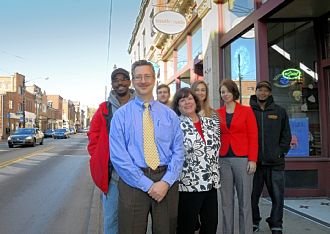
From left, Ron Goings, Rick Belloli, Aaron Sukenik, Judy Dyda, Rachael Glasder, Susie Puskar and DaVar Cutler of the South Side Local Development Co. -- Lake Fong/Post-Gazette
South Side Local Development Co., one of the most successful nonprofit real estate developers in Pittsburgh, will spend the next 18 months putting itself out of business.
The board decided to dissolve the little company whose 28-year tenure on the South Side has coincided with the neighborhood’s transformation in private property values, popularity and market economy.
A successor organization with a focus on public issues will be formed with community feedback to the South Side Planning Forum, the neighborhood’s umbrella for other groups, and the Pittsburgh Partnership for Neighborhood Development.
“This is an exciting transition, and I’m thinking of this as a huge success story,” said Ellen Kight, executive director of the Pittsburgh Partnership for Neighborhood Development. “They have really done what a (community development corporation) is supposed to do.”
Successful development corporations step in with public investment to help neighborhoods attract private investment. Some also have youth and job training programs, public safety committees and other outreach. The South Side nonprofit has largely focused on real estate and has built or renovated more than 100 homes in the past 20 years.
Private developers have added some 800.
“We’ve done our job,” said Tracy Myers, the company’s board president.
In 1982, when the company was founded, property values were two-thirds of the city’s median value, said executive director Rick Belloli. In 2008-09, those values were 170 percent of the city’s median. About 50 percent of the retail space along East Carson Street was vacant in 1982, and that rate is now at about 10 percent, he said.
Rob Stephany, executive director of the Urban Redevelopment Authority, said there is still work to be done by a high-capacity real estate nonprofit in the South Side’s adjacent neighborhoods.
“The target area is big, and the next step would be moving that [real estate] strength to the next frontier,” including Allentown and Arlington, he said.
“Clearly from a real estate value standpoint, the [development company] has been an invaluable piece of the puzzle,” he said. “The equity senior citizens have in their homes is growing, and that’s a proud moment. The fact that there are $400,000 sales in the South Side astounds me to this day.”
The remaining challenges largely have to do with the proliferation of bars, said Ms. Myers. “That’s a consequence of our success.”
The East Carson corridor’s accumulation of liquor licenses is considered to be at saturation by most stakeholders. Uncivil and drunken behavior on weekend nights has some homeowners at the breaking point. Resident Thomas Kolano said he is “very concerned a lot of people are actually talking about leaving the neighborhood.”
“If there isn’t a push-back from residents, this could become an undesirable place to live,” he said. “Sunday through Wednesday and some Thursdays it functions as a normal neighborhood — beautiful and vibrant. I love it. But Friday and Saturday are crazy. It’s like Jekyll and Hyde.”
The city has cracked down on parking violations in recent weeks, and Councilman Bruce Kraus has held several meetings to promote a management strategy for Carson businesses.
Mr. Stephany said a neighborhood improvement district “is an essential next step. The only way to correct some of the issues there is to have collaborative problem solving.”
A neighborhood improvement district is like a business improvement district, except it includes interests beyond those of businesses, such as parks. Participants pay a fee to have the interests of their stated district managed and maintained. The Pittsburgh Downtown Partnership is one example of a business improvement district.
A management strategy for East Carson businesses was recommended several years ago by consultants from the International Downtown Association. A committee of the South Side Planning Forum is gathering feedback to determine the range of focus of the successor organization.
The Pittsburgh Partnership for Neighborhood Development paid for an employee to go door-to-door to gather that feedback. The staff of the local development company will not be involved in the successor agency, although some of its board may be.
Ms. Myers said that while winding down, the agency “still has properties and buildings we want to make sure are well cared for. Some entity needs to keep an eye on these things, to protect all the progress we’ve made to improve the physical environment” and ensure that developers follow historic guidelines.
“Some things we do will have to be done by someone else or not get done,” she said. “The community has to set its priorities.”
-
Real Estate Workshop Celebrates City Living
Monday, November 01, 2010By Joe Smydo, Pittsburgh Post-GazetteUp hills, along tight curves and down into the river valleys, a bus full of local real-estate agents navigated Pittsburgh last week on a tour the Urban Redevelopment Authority put together to boost city home sales.
“I just got a whole different perspective,” said Mary Lynne Deets, education manager for the Realtors Association of Metropolitan Pittsburgh, who sold only about five homes in the city during a 30-year sales career.
That’s the kind of statistic the URA would like to change.
While open to all real estate professionals, the tour was designed to enlighten suburban agents unfamiliar with the city and all it has to offer. Officials hope their upbeat message will hit home, many times over.
“A lot of people want a walkable, pedestrian-friendly community to live in with a lot going on. That’s what urban living is all about,” said Kyra Straussman, URA real estate director.
Ms. Straussman said the URA ramped up home marketing efforts at Mayor Luke Ravenstahl’s direction about three years ago.
In May, the URA launched a Web site — Pittsburghcityliving.com — that pairs prospective home buyers with neighborhoods meeting their requirements. “It’s like Match.com for your neighborhood,” Ms. Straussman said.
The workshop for real estate agents, “City Living: A Focus on the Pittsburgh Client,” was another phase of the initiative. It was developed by Ms. Straussman; Josette Fitzgibbons, coordinator of the Mainstreets and Elm Street programs; and Megan Stearman, Mainstreets development specialist.
About 20 agents, most with little knowledge of the city, signed up. Under a special arrangement with the state Real Estate Commission, all received continuing education credits needed to maintain their licenses.
The agents saw new construction on the Central North Side, in Fineview and at Summerset at Frick Park. They heard about the house-by-house revival of Friendship, the development spurt in East Liberty and Lawrenceville’s recent emergence as a hot housing market.
They visited Riverview Park on the North Side, Pittsburgh Phillips K-5 on the South Side and Pittsburgh Brashear High School in Beechview. Sometimes, “neighborhood ambassadors” climbed aboard to talk about their communities and how civic groups augment the development work of city agencies.
“You know, we had rave reviews from the ‘students,’ ” Ms. Deets said, noting most continuing education workshops for real estate agents are classroom sessions on such issues as tax assessment and foreclosures.
Because the workshop was unusual, the Realtors Association had to persuade the Real Estate Commission to give the continuing education credits, Ms. Deets said. The participants did spend some time in a classroom, learning about tax abatement, other home buyer incentives and the Pittsburgh Public Schools.
To address concerns about the quality of city schools, the URA scheduled presentations about city magnet programs, the district’s academic improvement efforts and the Pittsburgh Promise college scholarship program. To counter other concerns about urban living, the URA arranged for the group to meet a man who’s raising two teenage girls on the South Side Flats and a single woman who lives in Allegheny West.
The URA plans to offer the workshop again in the spring. In the meantime, to track the success of last week’s program, the URA will send a thank-you gift to any participant who provides verification of a city home sale.
Ellen Connelly, a Howard Hanna agent who works mostly in the city, said the tour will make her job easier.
“I have an out-of-town client coming in. She’s looking at Sewickley. She’s looking at Fox Chapel. But she’s really focused on the city,” Ms. Connelly said.
-
Vanka’s Art Garnering More Attention
Wednesday, October 27, 2010By Mary Thomas, Pittsburgh Post-Gazette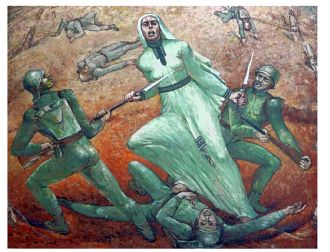
Maxo Vanka "The Battlefield" is a oil on canvas painting.
Residents often know of special places in their towns that don’t make it into tour books, from the eye-popping taxidermy in the back of Joe’s Bar in Ligonier to the best crab shack between D.C. and Baltimore.
A Pittsburgh secret that’s beginning to gain a wider reputation is St. Nicholas Croatian Catholic Church in Millvale. The nondescript little church is perched on a hillside in full view of thousands of Route 28 commuters, but few of them have seen the treasure inside.
That’s changing as more people learn about it through public programs such as the current exhibition, “Paintings and Works on Paper by Maxo Vanka,” at Pittsburgh Center for the Arts.
Maximilian “Maxo” Vanka (born 1889, Zagreb, Austria-Hungary; died 1963, Puerto Vallarta, Mexico) painted the murals that cover the interior of St. Nicholas in 1937 and 1941 as his way of expressing gratitude to his “adopted land.” What elevates them above traditional church murals is his incorporation of nationalistic and political subject matter.
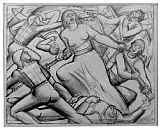
Maxo Vanka sketch study for the mural "The Battlefield."

Maxo Vanka mural "The Battlefield." The mural is at St. Nicholas Croatian Catholic Church in Millvale.
The center exhibition comprises 47 works by Mr. Vanka on loan from his descendants, the Brasko family in eastern Pennsylvania, including most significantly some of the drawings and paintings that were preparatory for the Millvale murals. These illustrate the compositional permutations Mr. Vanka tried out as he developed ideas and configured them for available spaces.
The works also show that he was an excellent draftsman, as in a beautifully realized sketch of a torso, or pencil drawings of scenes in New York’s Depression-era Bowery. Paintings range from a tender large family portrait of his wife and young daughter (he’s present as a reflection in a carefully placed mirror) to a gruesome anti-war protest parade.
While some of his themes, such as labor and family, were present in Works Progress Administration murals, Mr. Vanka’s Millvale works “contain a moral intensity and socially critical perspective not generally found in the idealized image of America that emerged within much of WPA art,” Barbara McCloskey, associate professor of art history, University of Pittsburgh, wrote in an essay for the nonprofit Society to Preserve the Millvale Murals of Maxo Vanka.
Dr. McCloskey also recommended Heidi Cook, a graduate student in Pitt’s Department of the History of Art and Architecture, to the society when it was looking for someone to catalog Mr. Vanka’s artworks and archives stored at the family home. Ms. Cook spent two weeks this summer in residence there, making notes about each work she uncovered, including size, inscription and label information when present, and condition, and photographing it. She then spent several more weeks in Pittsburgh to enter that information into a digital database.
She estimates there are approximately 1,000 artworks, including paintings, works on paper and sketches in storage, and that she was able to catalog about 20 percent during her stay. Ms. Cook observed that Mr. Vanka was “really prolific” and that he continued to paint throughout his life. She noted many smaller works, including still lifes and landscapes, possibly made to keep in practice, and large-scale paintings inspired by world travels with his wife, including of festivals in Japan and Bali. A powerful and disturbing painting inspired by an Indian leper colony is in the center’s show.
“What’s wonderful about the house,” Ms. Cook said, “is that there are photographs of when Vanka and his wife lived there, and it looks the same. The art is hung in the same places. The furniture is what he brought from Croatia. There are books that he used during his education.”
Ms. Cook initially intended to study modern German art, but her experience with Mr. Vanka has her considering the broader topic of Central and Eastern European art. She’s researching traditional folk costume — something Mr. Vanka incorporated to make political commentary — for her master’s thesis.
There is intent to catalog the remaining works, but that is dependent upon the society finding funding to do so. I hope that happens because such projects bolster knowledge about the artist and are essential steps to ensuring the art’s survival. Word-of-mouth equity can go only so far.
Three paintings by Mr. Vanka’s great-granddaughter, Marissa Halderman, that are responses to particular works of his, are also exhibited.
Vanka-inspired programs will be held at 6:30 p.m. Nov. 7 at the center, and at 3 p.m. Nov. 14 at St. Nicholas Church. They’re organized by HI-REZ, a local independent artist-driven initiative that facilitates nontraditional interactions between Pittsburgh artists and venues. Justin Hopper, (Multimedia project recounts chaotic days of Pittsburgh’s ordinary citizens in late 19th century) writer and artist, will read poetry, and the band Action Camp will perform compositions that each wrote in response to the murals. (Free and public.)
The exhibition continues through Nov. 7 at 6300 Fifth Ave. at Shady Avenue, Shadyside. Hours are 10 a.m. to 5 p.m. Tuesdays through Saturdays and noon to 5 p.m. Sundays. The center has produced a full-color catalog ($12) and poster ($18) for the exhibition. 412-361-0873 or http://pittsburgharts.org.
Artwork alertAn exceptional work of art, “Structure of Shadow” by Philadelphia-based artist Bohyn Yoon, is at the Pittsburgh Center for the Arts through Nov. 7.
Photography at Frick“Silver Worlds: Photography’s Wet Plate Era” is the subject of a talk beginning at 7 tonight by Linda Benedict-Jones for Conversations & Cocktails at The Frick Art Museum, Point Breeze. It’s held in conjunction with the exhibition “For my best beloved Sister Mia: An Album of Photographs by Julia Margaret Cameron.” Ms. Benedict-Jones is curatorial chair, exhibitions and curator of photography, Carnegie Museum of Art. Completing the evening will be hors d’oeuvres, a gallery discussion and the featured cocktail, the Royal Silver, which honors the silver halide coating critical in the production of photographs produced using the wet plate or collodion process (4 ounces champagne, 1/2 ounce Cointreau, 1/2 ounce Poire Williams liqueur, 11/2 ounces grapefruit juice). Advance registration with payment required at 412-371-0600; $25, members $20.
Carnegie Part IIThe second in Carnegie Museum of Art’s “What Are Museums For?” series, “Exhibitionists Unite: How Art Exhibitions Are Born,” will be held at 6:30 p.m. Thursday. Staff members will give an inside look at what goes into bringing a show to you, using the current exhibition “Ordinary Madness” and upcoming “Paul Thek: Diver, A Retrospective” as examples. Learn about the issues museum professionals resolve as they serve the public, and follow up with your own questions. Free; reception and cash bar follow. 412-622-3131 or www.cmoa.org.