Category Archive: Pittsburgh Post-Gazette
-
Water to Blame for Wall Collapse
Tuesday, February 15, 2011By Diana Nelson Jones, Pittsburgh Post-Gazette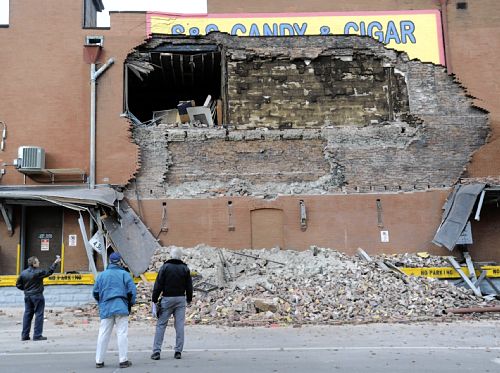
Pittsburgh building inspectors examine the partial collapse of a brick wall at S&S Candy and Cigar Co. at South 21st and East Carson streets on the South Side Monday morning. Bob Donaldson/Post-Gazette
Bricks and mortar rained onto 21st Street Monday morning, the likely result of water damage to the side of the S&S Candy and Cigar Co. at 2025 E. Carson St. on the South Side.
No one was injured.
An almost identical incident occurred in the morning when bricks fell from the side of a dentist’s office in Washington, Pa., damaging four cars.
Bob Farrow, division chief of Pittsburgh’s EMS department, said the outer layer of bricks on the S&S building gave out, followed by a crashing down of older bricks and mortar behind it.
The owner was not available to discuss the damage, but acting Bureau of Building Inspection Chief John Jennings said he suspected that water got in behind the veneer of bricks and pushed them out.
“We have seen this before, where water seeps in behind the brick, freezes and pushes the bricks out,” he said.
A structural engineer will be called in, he said. “We need to shore up the floor joists because they are compromised, but the damage is just to this one side. This building can be saved.”
Police closed South 21st Street between East Carson and Sidney streets. The parking lane alongside the candy store was covered with rubble.
Dozens of bystanders stared as the outer layer that had not fallen hung peeled back like a rind.
The candy and tobacco store has been in business in Pittsburgh since 1965.
In Washington, the brick facade of the dentist’s office detached without warning onto a side street, crushing four cars in the building’s parking lot.
Strong winds are being blamed for the collapse, according to what building owner Thomas C. Drewitz heard from insurers.
Emergency workers cordoned off the two-story building in the 800 block of Jefferson Avenue after the 10:40 a.m. incident. The city issued an emergency demolition permit to remove any loose bricks that had not fallen.
“Everything started to rumble and shake,” Dr. Drewitz said. “It went down fast.”
Dr. Drewitz said the building was constructed around 1965.
Three cars were totaled and a fourth suffered heavy damage.
“They were flat,” fire Capt. Nick Blumer said of the vehicles.
Dr. Drewitz closed the office for the day but said he planned to reopen today.
-
Construction Managers Picked for New Hill Grocery
Thursday, February 10, 2011
By Mark Belko, Pittsburgh Post-GazetteConstruction Managers Picked for New Hill Grocery
A Hill District grocery store is moving a step closer to reality.
The Hill House Economic Development Corp. announced today that it had hired the joint venture team of L.S. Brinker and CM Solutions to serve as construction managers for the project.
The minority-owned firms will oversee the construction of the 36,410-square-foot retail plaza on Centre Avenue that will contain a full-service Shop ‘n Save store. Brinker is headquartered in Detroit with offices in Pittsburgh, and CM Solutions is Pittsburgh-based.
Site work is expected to begin in March. The goal is to open the grocery before Thanksgiving. Besides the supermarket, the plaza will contain 6,900 square feet of commercial retail space.
-
Grant to Help Return Saxonburg Main Street to 1850s
Thursday, February 10, 2011By Karen Kane, Pittsburgh Post-GazetteSaxonburg’s Main Street program manager says he’s feeling “pretty blessed” by the news last month that the Pennsylvania Department of Transportation had come through with a $1.4 million grant.
The money was both needed and expected. But, Raymond Rush said he was happy it was all official.
“We’ve been blessed by PennDOT and beyond,” he said.
Design and engineering work is under way for reconstruction of both sides of Main Street — a four-block section of the street that spans about 2,200 feet from Butler Street to Rebecca Street. Those costs are being covered by a $373,027 grant awarded in May by the Department of Community and Economic Development.
Now, PennDOT has come through with a $1.4 million grant for construction of half of the project: from Pittsburgh Street west to Rebecca Street.
The work will involve reconstructing sidewalks and curbs, and installing landscaping. Street lights that replicate old-style German lights will be installed.
The first half of the project is to be under way in the second half of the year with finishing work in the first quarter of 2012, Mr. Rush said. Sometime early in 2012, he’s expecting to hear that PennDOT is coming through with the rest of the funding. The total project cost is estimated at $2.4 million. The second half of the project would start during the 2012 construction season. Mr. Rush predicted the job would be completed within a year’s time.
He credits receipt of the grants to a partnership between the borough and the John Roebling’s Historic Saxonburg Society Inc., a nonprofit group that sponsors the Main Street program. The society is named for the town’s founder who invented wire cable and is famous for bridge design. One of his most notable projects was the Brooklyn Bridge in New York.
Saxonburg’s Main Street is an official historic district on both state and national levels. There are 52 historic buildings in the four-block project area, including Mr. Roebling’s home. A native of Germany, he designed the borough.
Mr. Rush said the reconstruction project will maintain the borough’s historic look while modernizing the infrastructure.
“It will bring the 1850s look into modern society,” he said.
-
Vacant Motel Coming Down
Blue Spruce a Murrysville landmarkThursday, February 10, 2011By Laurie BaileyMurrysville’s landmark Blue Spruce Motel on Route 22 will be demolished at the end of this month.
“Basically, it’s going to be a flat piece of land,” said Hallie Chatfield, revitalization coordinator at the Westmoreland Redevelopment Authority. The organization is funding the demolition contract awarded to A.W. McNabb LLC of Burgettstown. Ms. Chatfield said the $56,800 grant for the work comes from a federal Community Development Block Grant.
Work that will result in the demise of the motel, pool, pool house and beverage area was originally scheduled to start Monday, but the necessary equipment was unavailable, said Ms. Chatfield. A.W. McNabb is contracted to complete the work within 90 days.
“They will first need to do an internal clean-out before they can demolish it,” said Ms. Chatfield who noted the outside probably wouldn’t be coming down for two more weeks.
In 1956, Camille Naffah purchased the five-acre property for $7,500 and tore down the original structure, the ’40s-era John’s Motel. In its place, he built the Blue Spruce, a single-level motel with clean, simple architecture. In the summer, the large public pool attracted locals from surrounding communities.
Stuart Patz remembered coming out to swim as a high school and college student from his Stanton Heights home in the late 1950s and early 1960s when there were few other public pool options.
“All the kids from the East End were there. It was very pleasant and a nice, social thing. I have such great memories, a real nostalgic feeling toward the facility,” said Mr. Patz, now living in Washington, D.C.
In the mid-’80s, a second level, a restaurant and bar were added to the structure. Mr. Naffah lived in an apartment above the motel’s lobby.
In 1996, the aging motel gained brief local notoriety as a location for the movie, “Kingpin,” with Woody Harrelson.
“They really fixed it up, repainted the outside pink and blue,” said John Cardwell, executive director of the Murrysville Economic and Community Development Corporation.
For several years, the property has been vacant, with the paint in the abandoned pool increasingly chipping.
“The motel closed about four years ago. The pool probably has been closed for 10-plus years,” Mr. Cardwell said.
Mr. Naffah tried unsuccessfully to sell his motel in 2005 before his death in 2007. He left the property to his employee, Emily Moroney, who also died that same year.
Currently, the Blue Spruce is part of the estate of Ms. Moroney, which approved the demolition in hopes of making the property more attractive to developers, Mr. Cardwell said.
Right now, there are no plans for the land, which includes a one-acre “banner parklet” adjacent to the Blue Spruce. It is also for sale with the property and is owned by the development corporation.
“I think there is a vision that is consistent with the streetscape study done in the ’90s,” Mr. Cardwell said.
That vision includes small shops and offices.
-
Allegheny Grows Funds First-Year Projects in Wilkinsburg, Bellevue and Penn Hills
Thursday, February 10, 2011By Len Barcousky, Pittsburgh Post-GazetteAllegheny Grows Funds First-Year Projects in Wilkinsburg, Bellevue and Penn Hills“Allegheny Grows” is itself growing with urban-agriculture projects spreading to three more communities.Allegheny County Executive Dan Onorato will announce today that Bellevue, Wilkinsburg and Penn Hills will be the sites this spring of new urban farms and community gardens.
This year is the second for the program designed to dress up empty lots, build community spirit, encourage local organizing, aid the environment and provide fresh produce for local food pantries.
“Allegheny Grows builds on the county’s ongoing initiatives to revitalize older communities and distressed municipalities through sustainable development and strategic investment,” Mr. Onorato said in a statement.
A dozen communities competed to participate in this year’s program.
The three that were chosen were selected for their strong leadership, enthusiasm of local volunteers, suitability of their garden site and community need, project manager Iris Whitworth said. She works for the business development unit of the county’s economic development office.
Allegheny Grows has a budget this year of about $75,000. In addition to setting up the three new agricultural projects, the funds will be used to cover second-year costs for garden projects begun last year in Millvale and McKees Rocks. The source of the money is federal community development block grants.
The effort is a collaboration with Grow Pittsburgh and local partners in each community. Grow Pittsburgh was formed in 2005 to encourage city gardening.
Bellevue’s project will be a urban farm on Davis Avenue on a 1-acre vacant tract owned by North Hills Community Outreach. The land had been donated in 2008 to the social-service agency by the Amelio family for an organic garden, according to Fay Morgan, executive director of North Hills Community Outreach.
North Hills Community Outreach is a faith-based social-service agency that serves families and individuals in communities north of Pittsburgh. Most of the labor for the organic farming effort will be provided by volunteers, supervised by a part-time agency employee. Produce grown there will be donated to food pantries.
Wilkinsburg’s urban farm is a 2-acre site in the city’s Hamnett Place neighborhood. The land is owned by Pittsburgh History and Landmarks Foundation, which already is involved with several housing renewal projects in the community. Allegheny Grows will be working with a citizens organization called Hamnett Place Community Garden Association to plant and care for the site.
Penn Hills officials are providing a water truck and leaf-mulch compost for a community garden on the site of a former municipal ballfield. The tract had been planted as a garden last year by a youth group. Produce grown through this year’s effort will benefit up to three local food pantries.
Second-year Allegheny Grows’ assistance to gardens in Millvale and McKees Rocks will include providing both seedlings and some technical advice from Grow Pittsburgh. Millvale also will receive several rain-collecting barrels and McKees Rocks will get help in edging its garden beds and making them accessible to people with disabilities.
-
Deal Reached to Save Historic Franklin County House
Tuesday, February 08, 2011By Len Barcousky, Pittsburgh Post-GazetteDeal Reached to Save Historic Franklin County House
A history-loving physician has worked out a deal to save an 18th century home in Mercersburg.
Dr. Paul Orange said today the William Smith House will be taken apart piece by piece over the next several weeks and reassembled on a new site elsewhere in the Franklin County community.
The future of the building has been in question since the structure and land on which it stands were acquired two years ago by a local volunteer fire company. The MMP&W Fire Co., which has its headquarters and garages next door to the house on Main Street, bought the property for expansion and had announced plans to demolish the building.
That news resulted in the creation of a citizens group, the Committee to Save the Justice William Smith House. Members say that events planned in the stone Ulster-style cottage in 1765 resulted in the earliest opposition to British rule in the American colonies and laid the groundwork for the Second Amendment to the U.S. Constitution. That amendment guarantees the right to bear arms.
Dr. Orange, who has a family medical practice outside Chambersburg, estimated that the relocation project will cost as much as $250,000. He has agreed to fund at least $50,000 of that amount.
The first steps involve removing 19th- and 20-century additions to the structure, carefully taking apart and numbering stones and timbers from the core of the building and arranging for storage nearby. That process is likely to take several weeks, he said.
No decision has been made on where the house will be rebuilt. Several suitable properties are vacant along and near the borough’s Main Street.
Mercersburg is about 150 miles southeast of Pittsburgh.
-
Around Town: Point of Realism Interferes With Preserving Arena
Tuesday, February 08, 2011By Brian O’Neill, Pittsburgh Post-GazetteAround Town: Point of Realism Interferes With Preserving Arena
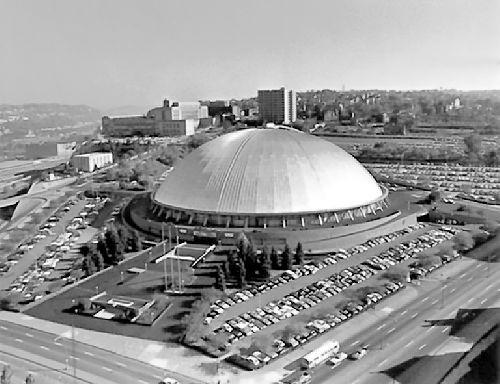
An architectural superstar of its time. And now?
The Civic Arena can still pack ’em in. It was standing-room-only last week at the Pittsburgh Historic Review Commission meeting on Ross Street, just down the hill from the vacated hockey palace.
Some very smart people made a polished and impassioned presentation that showed the 49-year-old Igloo to be an architectural superstar, an engineering marvel and the symbol of Pittsburgh’s Renaissance, rising just as the city’s skies were clearing.
What nobody offered, though, is what practical use it has now. In the past quarter-century, three multipurpose arenas of ascending size — the 5,400-seat Palumbo Center, the 12,500-seat Petersen Events Center and the 19,000-seat Consol Energy Center — have been built within two miles of the place.
This city needs another arena like it needs a hole in the Hill.
To be fair, it wasn’t the job of preservationists this day to offer a practical new use for the empty building. The question was whether the Civic Arena should be designated a historic structure.
But if the commission votes next month to grant historic designation (preliminary approval last month is no guarantee), that would prevent the city-county Sports & Exhibition Authority from demolishing the arena. That would muck up the Penguins’ development plans for the 28-acre site, and the most prominent Hill District leaders don’t want those plans blocked. Residents have been waiting 50 years to get their neighborhood back.
Both preservationists and those who want to see office buildings, stores and about 1,200 new homes built at the site agree on one thing: The way the Hill District was treated when the arena site was cleared in the 1950s was a civic crime. About 1,300 buildings, 400 businesses and 8,000 lower Hill residents got the heave-ho. Promises of better housing were never kept, and the highway ditches and largest park-for-pay lot in Western Pennsylvania are the neighborhood amputation scars.
Rob Pfaffmann, the Downtown architect who has spearheaded the Reuse the Igloo campaign, suggests that keeping the building can help future generations remember that painful history. He quoted the native son who did the most to celebrate the neighborhood, the late playwright August Wilson, who said, “My plays insist that we should not forget or toss away our history.”
Mr. Pfaffmann even broke out a Rick Sebak video on the arena. (The video player, like the Igloo’s acoustics, went awry shortly.) But neither Mr. Pfaffmann nor the city’s premier architectural storyteller, Franklin Toker, could persuade Hill leaders that this mammoth steel assemblage would be anything but a humongous kink in plans to reknit the neighborhood into Downtown.
City Councilman Dan Lavelle said the commission’s mission statement also speaks to the preservation of neighborhoods. He hoped it would pay attention to community residents rather than those with fond memories of coming to the lower Hill “to listen to the Beach Boys at the expense of those who lived there.”
This “case study of urban renewal gone wrong,” which isolated and divided the Hill, is “not the sort of history we wish to preserve,” Mr. Lavelle said. Preserving it, he said, would be like flying Confederate flags on state buildings in the South.
Paying $50,000 a month to maintain it, or tens of millions of dollars to modify it for a new use, would not be a smart move for a strapped city, he concluded.
What do you do with a spare arena? Modification plans all seem a bit like getting a bear to ride a bicycle. It can be done, but that’s not really what either bears or bicycles are for.
What about saving part of it? TV actor David Conrad, in a videotaped presentation, said he understood why neighborhood residents want the arena erased, but saving a piece could “transform an insult into pride.” Preservation of a remnant would be akin to the iconic murals of saints, he said, which often show the martyred figures holding the very weapons that killed them.
Sala Udin, who formerly held the council seat in the Hill, didn’t think the neighborhood would oppose a “remnant that stayed as some kind of icon.” But full preservation would block development plans.
Penguins President David Morehouse said preserving a remnant, as was done with the Forbes Field outfield wall, is possible, but “you can’t have half of a dome in the middle of your development.”
The Hill’s comeback has to be the primary goal. That started more than 20 years with the hugely successful Crawford Square townhouse development just east of the arena. With gasoline prices soaring, building another 1,200 new homes in the heart of the region is about the best news a shrinking city could get.
-
Picketing Planned to Save Historic Mercersburg House
Saturday, February 05, 2011By Len Barcousky, Pittsburgh Post-GazetteWhen the British government failed to protect their homes and farms, residents of Pennsylvania’s Conococheague Valley gathered in 1765 at a house in what is now Mercersburg to organize themselves into a militia.
That historic house may be demolished to make room for a volunteer fire company’s expansion, and some 21st century residents plan to gather this weekend to oppose that plan.
“It will be a peaceful protest,” said Tim McCown, a spokesman for the Committee to Save the Justice William Smith House. “We want the fire board to see that the community is behind saving the house.”
Participants will gather at 8 a.m. today, Sunday and Monday in front of the property on Mercersburg’s Main Street. They will hand out fliers describing the building’s history and will outline efforts to rescue or relocate it.
The house and land on which it stands belong to the MMP&W Fire Co., which acquired them in August 2009. The initials in its name stand for the Franklin County communities it serves: Mercersburg, Montgomery, Peters and Warren. They are about 150 miles southeast of Pittsburgh.
The site is next to the fire company’s aging garage and headquarters. Fire officials have said they were interested in only the land. Plans to demolish the building, however, have been on hold since a Chambersburg physician came forward with a plan to relocate the house to a vacant lot across the street. That property had been occupied by a gas station. Dr. Paul Orange has said he was willing to cover the costs of moving the building if it will save it from demolition.
Dr. Orange placed $10,000 in an escrow account as a show of good faith while sporadic talks have continued with the firefighters and the demolition firm. The parties, however, have been unable to come to an agreement.
The relocation plan has support from Mercersburg Mayor James Zeger and some members of borough council. Dr. Orange said he was hoping to enlist their aid in setting up another meeting with the firefighters.
Supporters of the house are worried, however, by signs of activity around the Smith house that they fear are preparations to start the demolition. A chain-link fence was put up Thursday.
A spokesman for the fire company did not return calls seeking comment.
William Smith was an 18th-century businessman and local magistrate. His home, originally a one-story stone cottage, has been altered and renovated extensively in the 250 years since it was built.
His house was the meeting place for mostly Scotch-Irish settlers who armed and organized themselves into militia units. Their purpose was to protect themselves from raids by Native Americans who opposed white settlement in the region.
William Smith’s brother-in-law, James Smith, took armed resistance one step further. Among the settlers’ complaints was that Philadelphia merchants were sending arms and ammunition to Fort Pitt, knowing that some of those weapons would be sold to hostile Native American warriors.
Eight years before Bostonians dressed up like Indians to throw British tea into Boston Harbor, James Smith led disguised settlers in a raid on pack trains heading west. Smith’s “Black Boys” confiscated and destroyed supplies they thought might aid their Indian foes.
When the British sent troops to nearby Fort Loudon to protect the traders, the soldiers found themselves surrounded and besieged by angry frontiersmen.
Those actions, years before the Boston Tea Party, were the first shots of the American Revolution, Mr. McCown said. The activities of the frontier militia also laid the groundwork for the Second Amendment to the U.S. Constitution — the right to bear arms, he said.